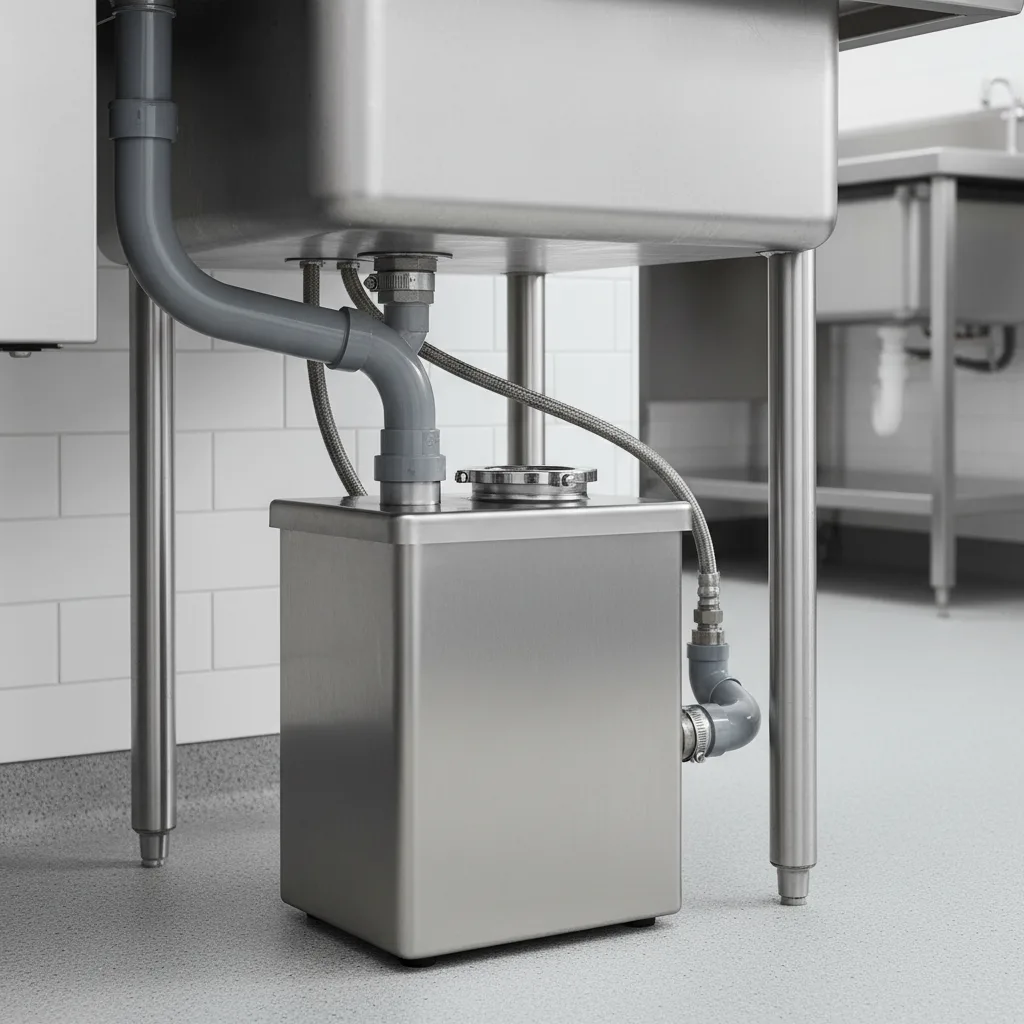
Grease trap baffles fail more often than most restaurant owners realize — and when they do, your entire grease management system stops working effectively. Baffles control wastewater flow, separate FOG (fats, oils, and grease) from liquid, and prevent solids from entering your drainage system. This guide explains when to replace your grease trap baffle, what it costs, and how to handle the job correctly.
What Grease Trap Baffles Do and Why They Fail
A grease trap baffle is a vertical barrier inside your trap that forces wastewater to flow in a controlled pattern. Most traps use two baffles — an inlet baffle that directs incoming wastewater downward beneath the grease layer, and an outlet baffle that allows only clarified water to exit while blocking FOG and solids. Without functioning baffles, grease flows straight through your trap and into the sewer line.
Baffles fail for three primary reasons: chemical degradation from harsh cleaning agents, physical damage from improper pumping techniques, and material fatigue from constant exposure to hot wastewater and acidic conditions. PVC and polypropylene baffles typically last 5–8 years in commercial kitchens, while stainless steel baffles can last 15–20 years depending on usage intensity.
Never pour caustic drain cleaners into grease traps. These chemicals accelerate baffle deterioration and can void equipment warranties. Most health departments also prohibit caustic chemicals in grease management systems.
When baffles deteriorate, they develop cracks, warp out of position, or detach completely from mounting brackets. Inlet baffles often show damage first because they receive the direct impact of hot wastewater and food particles. Outlet baffles fail less frequently but cause more immediate problems when they do — a broken outlet baffle allows grease to escape directly into your drainage system.
Signs Your Grease Trap Baffle Needs Replacement
Visible cracks or warping on the baffle surface indicate imminent failure. Inspect your baffles during regular pump-outs by asking your service technician to check baffle condition, or look yourself after the tank is pumped. Cracks wider than 1/8 inch require immediate replacement — even small cracks allow grease and solids to bypass the separation process.
Increased grease buildup in your drainage lines downstream from the trap signals baffle failure. If you're experiencing more frequent drain clogs despite regular grease trap pumping, your outlet baffle likely isn't blocking FOG effectively. Similarly, if your trap fills with grease faster than normal or requires more frequent pump-outs, your inlet baffle may have failed.
A functioning baffle should extend from above the waterline to within 6–12 inches of the tank floor. If your baffle doesn't reach these positions, it's not doing its job.
Foul odors intensifying near floor drains or the grease trap itself suggest baffle displacement. When baffles shift out of position, they create air gaps that allow sewer gases to escape. You may also notice wastewater backing up faster during peak service hours — a sign that water isn't flowing through the baffle system properly.
Schedule baffle inspections every 90 days, coordinating them with your regular pump-out service. Most haulers include visual baffle checks in their service, but request documentation of baffle condition in writing.
Failed inspection citations specifically mentioning baffle condition require immediate action. Health inspectors check baffle integrity during grease trap inspections because defective baffles directly cause FOG discharge violations. Don't wait for a second citation — baffle replacement takes 1–3 hours for most commercial installations.
Grease Trap Baffle Replacement Costs
Baffle replacement costs depend on trap size, baffle material, and whether you hire professional installation. For a typical 50-gallon under-sink trap, expect to pay $150–$300 for polypropylene baffles or $400–$600 for stainless steel baffles. Larger in-ground interceptors (1,000+ gallons) require baffles costing $800–$2,500 depending on custom sizing requirements.
Professional installation adds $200–$500 for under-sink units and $500–$1,500 for in-ground interceptors. The price difference reflects labor complexity — in-ground baffles often require confined space entry equipment, multiple workers, and traffic control if the interceptor is located in a parking area or alley. Some municipalities require licensed plumbers to perform baffle replacement, which increases labor costs by 20–30% compared to general grease trap service companies.
Material choice significantly impacts long-term costs. Polypropylene baffles cost 40–60% less upfront but require replacement twice as often as stainless steel. For high-volume kitchens processing 200+ meals daily, stainless steel baffles deliver better total cost of ownership despite higher initial investment. Mid-volume operations often find polypropylene adequate for 6–8 year service intervals.
Emergency replacement outside business hours typically carries 50–100% surcharges. If a baffle fails during operation and causes immediate drainage problems, you'll pay premium rates for same-day service. Regular inspections prevent most emergency situations and keep replacement costs predictable.
DIY vs. Professional Baffle Replacement
Replacing baffles in under-sink grease traps qualifies as a reasonable DIY project for mechanically inclined restaurant operators. The process requires pumping the trap completely, removing the cover, unbolting or unclipping the old baffle, and installing the replacement according to manufacturer specifications. You'll need basic tools, replacement gaskets, and about 90 minutes of work time.
Order replacement baffles by trap model number — universal baffles rarely fit correctly and create new problems. Contact your trap manufacturer or check the equipment nameplate for exact model information. Most manufacturers sell direct replacement parts through distributor networks or online, with 3–7 day delivery standard.
Take photos before removing the old baffle, documenting its position, angle, and how it connects to mounting hardware. These photos guide correct installation and help troubleshoot if the replacement doesn't fit as expected.
In-ground interceptor baffle replacement requires professional service in nearly all cases. These installations involve confined space entry, which triggers OSHA safety requirements including atmospheric testing, ventilation equipment, and rescue provisions. The liability and equipment costs make professional service the only practical option for in-ground units.
Professional installation also provides warranty coverage that DIY work doesn't. Most grease trap service companies warranty baffle installation for 1–2 years, covering both parts and labor if the baffle fails prematurely due to installation error. This protection often justifies the installation cost, particularly for operations where drainage failure means closing the kitchen.
For guidance on overall grease trap system maintenance beyond baffle care, explore additional resources on the GreasetrapLocator blog.
Frequently Asked Questions
How often should grease trap baffles be replaced?
Polypropylene baffles typically need replacement every 5–8 years in commercial kitchens, while stainless steel baffles last 15–20 years. Actual replacement intervals depend on water temperature, chemical exposure, and how frequently the trap is pumped. Schedule professional inspections every 90 days to catch deterioration before baffles fail completely.
Can I replace just one baffle or do both need replacement?
You can replace individual baffles if only one shows damage, but replacing both simultaneously is more cost-effective. Labor costs don't change significantly whether you replace one or both baffles, and matching baffle age prevents uneven wear. If one baffle has failed, the other is likely near end-of-life anyway.
What happens if I operate a grease trap with a broken baffle?
Operating with a broken baffle allows FOG to bypass the separation process and enter your drainage system, leading to sewer line blockages and potential health code violations. Most jurisdictions classify this as illegal discharge of prohibited wastes, with fines ranging from $500–$5,000 per violation. The trap also loses efficiency, requiring more frequent pump-outs.
Do I need a permit to replace grease trap baffles?
Most jurisdictions don't require permits for like-for-like baffle replacement, but modifying baffle configuration or changing trap capacity does require permits. Check with your local plumbing department before starting work. Some areas require licensed plumbers to perform any grease trap repairs, even simple baffle swaps.
How do I know what size replacement baffle to order?
Check your grease trap's model number on the equipment nameplate or in your installation documentation, then order manufacturer-specified replacement parts. If you can't locate model information, measure the existing baffle's height, width, and mounting hole spacing, then contact a grease trap parts supplier with these dimensions for proper sizing.
Find verified grease trap services in your area at https://www.greasetraplocator.com
Find verified, local contractors who handle cleaning, pumping, and FOG compliance — in your area.
