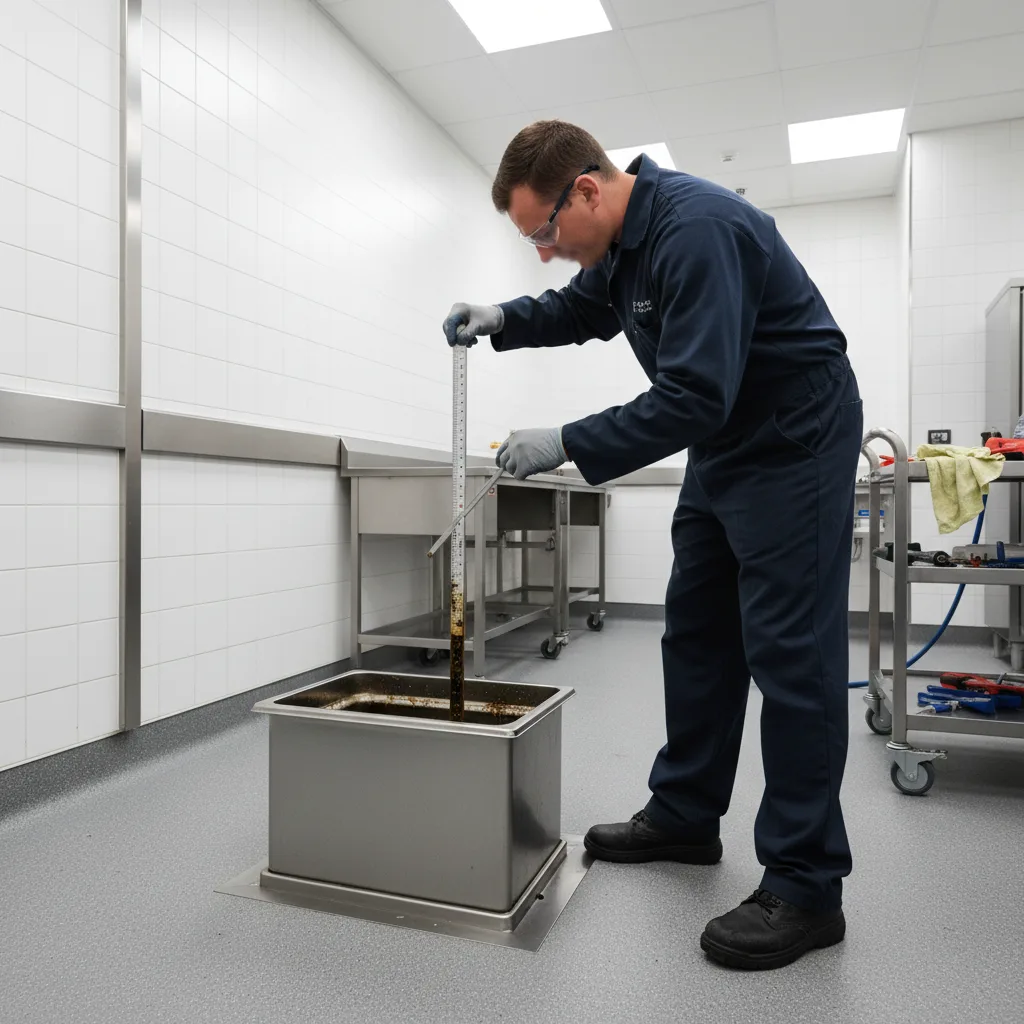

Short answer: a grease trap or grease interceptor is required for many restaurants and other food businesses, but the final answer depends on the rules for the property’s exact address, menu, equipment, and drains. There is no single U.S. or Canadian rule that makes every business identical.
Fact-checked against government and municipal sources on August 10, 2026.
The safest time to confirm the requirement is before signing a lease, buying equipment, or changing the kitchen. Ask the sewer or wastewater authority that serves the address for a written answer. The building or plumbing reviewer may also need to approve the device and its size.
When is a grease trap usually required?
A local review is especially likely when a business:
- cooks, heats, processes, or prepares food on-site;
- washes dishes, pots, pans, utensils, trays, or food-preparation equipment;
- has sinks, floor drains, dishwashers, or other fixtures that can receive fats, oils, or grease;
- is opening, remodeling, changing its menu, or taking over an existing food space; or
- needs a food-business permit or commercial-kitchen plumbing review.
Those are practical warning signs, not a substitute for the local code. The U.S. Environmental Protection Agency describes pretreatment as a cooperative federal, state, and local program and explains that municipalities perform much of the permitting and enforcement for wastewater entering local sewer systems. In other words, federal rules provide the framework, while the requirement that applies to your kitchen is commonly set and enforced closer to home.
Two businesses with the same menu can face different requirements because they are served by different sewer authorities or are working under different local plumbing rules.
Read the transcript
Narrator: Grease slips down the kitchen drain.
Narrator: In the sewer, it cools, hardens… and can block the pipes.
Restaurant owner: …That’s not good.
Narrator: That’s why many cities require a grease trap: catch it first.
Restaurant owner: Done.
Narrator: Not quite. Traps fill up, so they’re pumped out regularly.
Narrator: How often? What records? Your local rules decide.
Restaurant owner: So… who do I call?
Narrator: GreaseTrapLocator helps you find grease trap services near you. Contact them directly.
On screen: Catch it first. Find a grease trap contractor. greasetraplocator.com. Free to use.
Do coffee shops and cafés need grease traps?
Sometimes—and the local differences are significant. Coffee alone does not produce one universal exemption. What the shop serves, what it prepares, how it washes equipment, and which local rule applies can change the result.
- Austin, Texas: Austin Water says food-preparation businesses need an approved interceptor, but a drinks-only business can request approval to operate without one. That exception is not automatic.
- Seattle, Washington: Seattle Public Utilities says businesses with commercial-kitchen plumbing fixtures and a King County Food Business Permit need a grease interceptor, and it specifically names coffee shops among small food-service businesses covered.
- Toronto, Ontario: Toronto says food-service establishments must install, operate, and maintain grease interceptors on connections to the sanitary sewer. Its examples include coffee shops where food is cooked, heated, processed, or prepared.
A beverage-only counter in one city may therefore receive a different answer from a café that bakes, reheats food, washes reusable dishes, or operates under another city’s rules.
What should a coffee-shop owner ask?
Send the authority your proposed menu and a complete equipment list. Include espresso machines, milk pitchers and rinser stations, sinks, dishwashers, ovens, warmers, drains, and any food-preparation equipment. Ask: “Does this exact operation at this address require a grease trap or interceptor, and what plan or sizing method do you require?”
Restaurants, bakeries, food trucks, and other operations
Full-service restaurants and commercial kitchens commonly need grease control because their wastewater can contain fats, oils, and grease. But labels alone do not decide the result. Bakeries, delis, grocery food counters, mobile vendors, institutional kitchens, and limited-service businesses may be included, treated differently, or reviewed case by case.
For example, Toronto’s current guidance includes restaurants, coffee shops, bakeries, food trucks, and institutional kitchens when they fit the city’s food-service definition. British Columbia tells commercial kitchens whose wastewater contains fats, oils, and grease to use a properly installed and maintained interceptor and to confirm the details with the regional district.
The useful question is not simply “What kind of business am I?” It is: what enters the drains, which fixtures receive it, and what does the authority serving this address require?
How to get a reliable answer before you spend money
- Identify the sewer or wastewater authority. This may be a city department, county, water utility, sanitation district, or regional district.
- Prepare one complete description. Include the address, menu, hours, seating, expected volume, kitchen plan, and every sink, drain, dishwasher, and food appliance.
- Describe any existing unit. Provide its location, model, capacity, condition, and available service records. Do not assume a former tenant’s approval transfers to a new concept.
- Ask which other reviewers are involved. The authority may direct you to building, plumbing, health, or industrial-waste staff.
- Request the answer in writing. Keep the approval, calculation, plan, permit, and maintenance instructions with the property records.
Confirm the required type, approved size, installation location, connected fixtures, permit steps, and maintenance records. A product selected from a generic chart may not pass the local review.
Who enforces grease-trap requirements?
Responsibility varies. Sewer or industrial-waste staff commonly enforce discharge rules; building or plumbing officials may review installation and sizing; and health or food-business staff may be involved in opening approval. New York City, for example, places its grease-interceptor rules and inspections with the Department of Environmental Protection and requires licensed plumbers for installation. That is an NYC rule—not proof that every jurisdiction follows the same process.
Consequences also vary. Local authorities may require corrections, issue penalties, or take other action when a required device is missing, undersized, or poorly maintained. Check the current local rule instead of relying on a national fine range.
Frequently asked questions
Are grease traps required by law?
They are required for many food businesses, but there is no single rule that answers the question for every address. The controlling requirement usually comes from local sewer-use rules, plumbing rules, and the plan-review process. Ask the wastewater or sewer authority that serves the property for a written determination before opening or renovating.
Does a coffee shop or café need a grease trap?
Sometimes. Menu, food preparation, dishwashing, plumbing fixtures, and local rules all matter. Austin Water lets a drinks-only business request approval to operate without an interceptor, while Seattle explicitly includes coffee shops with commercial-kitchen plumbing and a King County Food Business Permit. Toronto also includes coffee shops where food is cooked, heated, processed, or prepared. Confirm your exact address and equipment with the local authority.
Does a commercial dishwasher mean I need a grease trap?
A dishwasher is an important sign that a grease-control review is needed, but it is not a safe nationwide yes-or-no test. Some local rules focus on dishwashing or grease-bearing fixtures; others focus on food preparation or the wastewater the business produces. Include every dishwasher, sink, drain, and food-preparation appliance when asking the local authority.
Can I use the grease trap left by the previous restaurant?
Do not assume it is approved for your operation. A change in menu, equipment, seating, plumbing, or ownership can affect the review. Ask the local wastewater and plumbing reviewers to confirm in writing that the existing unit, location, and capacity are acceptable for your plans.
Who determines the correct grease trap size?
The local authority's rules control the approved method and final decision. A qualified plumbing professional can prepare the calculation and plans, but the reviewing authority should confirm what it will accept. Do not buy a unit from a generic online chart before the plan review is complete.
How often must a grease trap be cleaned?
There is no universal schedule. Follow the local rule, the approved maintenance plan, and the manufacturer's instructions. New York City, for example, says an interceptor should be cleaned as often as necessary to avoid exceeding its rated capacity. Keep the records your local program requires.
Official sources used
- U.S. EPA — National Pretreatment Program
- U.S. EPA — Controlling Fats, Oils, and Grease Discharges from Food Service Establishments
- Austin Water — Pretreatment Requirements and Grease Interceptor Variances
- Seattle Public Utilities — FOG for Commercial Kitchens
- NYC Department of Environmental Protection — Disposing of Grease as a Business
- City of Toronto — Mandatory Grease Interceptors for Food Service Establishments
- Government of British Columbia — Grease Interceptors
Scope note: This page provides general information, not a permit decision for a particular property. Rules can change; the written determination from the authority serving the address controls.
Find a local company to inspect, clean, or service your grease trap.Find grease trap services

Author: Grease Trap Locator Editorial Team
The Grease Trap Locator editorial team covers FOG compliance, grease trap maintenance, and commercial kitchen regulations across the US and Canada. Our guides are written for restaurant owners, facility managers, and food service operators who need practical, accurate information without the fluff.
Find local contractors who handle cleaning, pumping, and FOG compliance — in your area.