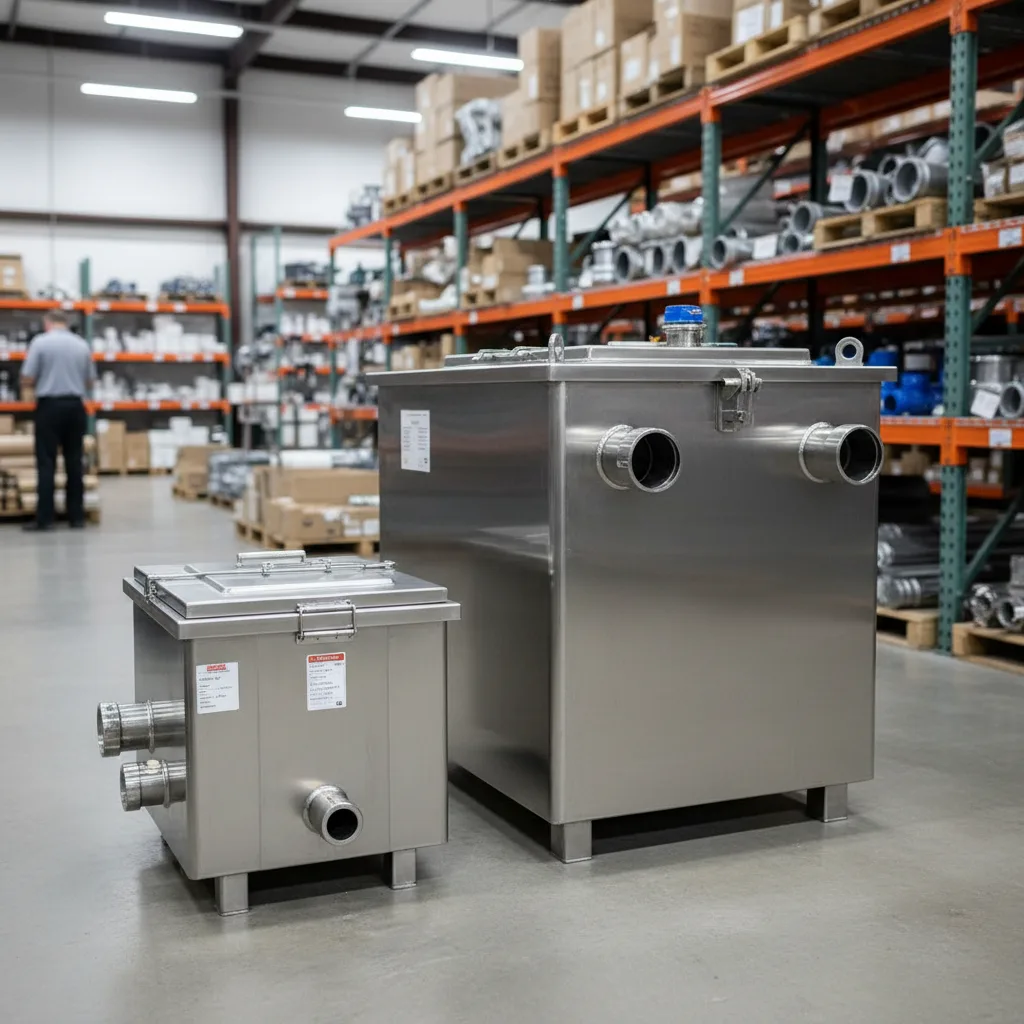

A grease trap or interceptor has to be sized for the kitchen it serves. The U.S. EPA says these devices "must be designed and sized appropriately to allow FOG to cool and separate in a non-turbulent environment." There is no single national sizing formula. This guide explains what sizing depends on and walks through real methods published by Austin, Phoenix and Savannah. Your own approving authority decides which method applies and what size you install.
Understanding Grease Trap Capacity Requirements
Grease trap sizing isn't guesswork. Published methods start from the fixtures that drain to the device: how many there are, their drain sizes, and in some methods the volume of each sink. Fixture flow values come from the method you use. Savannah's gravity-interceptor table, for example, sets a pot-washing sink such as a 3-compartment sink at 14, 30, 54 or 61 GPM depending on a 1.5-, 2-, 2.5- or 3-inch drain pipe. Understanding which fixtures in your commercial grease management system connect to the trap determines your baseline calculation.
Sizing also depends on the device type. One widely referenced standard is the Plumbing and Drainage Institute's PDI-G101, used for smaller hydro-mechanical interceptors. Savannah, for example, sizes those units under PDI-G101 but sizes outdoor gravity interceptors with a different method.
For larger interceptors, Austin and Phoenix multiply the fixture flow by a retention time to get a minimum tank size in gallons. The time used in the calculation depends on the device and the authority. Austin uses a 12-minute total retention time in most cases, Savannah's gravity-interceptor method uses a 30-minute detention time, and Savannah's PDI-G101 worked example for small hydro-mechanical units uses a one-minute sink drain-down period instead. Count fixtures according to each authority's inclusion and exclusion rules. Do not assume you can discount the calculated load because fixtures drain at different times.
Who decides: your local sewer or pretreatment authority and plumbing or building official approve the size. A method from another city is an example, not permission for your kitchen.
Step-by-Step Grease Trap Sizing Calculation
1. Find your approving authority and its method. Ask your local sewer or pretreatment authority which device type it expects (a hydro-mechanical unit inside, or a gravity interceptor) and which sizing method it uses. Check what the permit covers and whether separate plumbing, building or equipment approvals are also required.
2. List every fixture that drains to the device. Walk through your kitchen with a plumbing diagram and note each sink, dishwasher, floor drain, floor sink and prep station that will connect. Don't size for the main dish sink alone. Savannah's list of fixtures that must drain through the interceptor includes mop sinks, food prep sinks and floor drains.
3. Apply that authority's method. Three published examples:
- Austin's method (Austin Water): count fixture units from Austin's tables, which depend on the fixture, how it is connected and its trap size (in Austin's table for fixtures connected indirectly through a floor sink or hub drain, a 3-compartment sink is 4, 6 or 8 fixture units for a 2-, 3- or 4-inch trap). Flow rating = total fixture units × 3 gallons per minute. Minimum liquid holding capacity = flow rating × 12 minutes.
- Phoenix's method (City of Phoenix): assign 3 gallons per minute to each connected fixture unit, then multiply by the required retention time. Phoenix lets designers use a fixture's actual maximum waste flow instead, but only when engineering calculations and manufacturer data back it up.
- Savannah's methods (City of Savannah Grease Interceptor Standard, revised May 2015): for gravity interceptors, add up each fixture's flow from Savannah's table, multiply by a 30-minute detention time, then add one third of that volume for grease and solids storage. For hydro-mechanical units, use the PDI-G101 sink-volume method shown in the first example below.
Some methods build in solids storage. Savannah's gravity-interceptor method adds storage equal to one third of the discharge volume, so that 25% of the tank is set aside for grease and solids. Don't add your own margin on top of an approved method unless the reviewer asks for it.
Don't discount fixtures because they rarely run at the same time unless your approving authority's method allows it. Phoenix's published example counts every connected fixture.
4. Get written approval before you buy. Austin Water tells businesses not to purchase a grease trap or interceptor before getting building plan approval and an approval letter that specifies the required size and design.
Example using Savannah's method (hydro-mechanical interceptor, PDI-G101)
This is the worked example in Savannah's standard, for one sink 48 inches long, 24 inches wide and 12 inches deep:
- Sink volume: 48 × 24 × 12 = 13,824 cubic inches.
- Capacity: 13,824 ÷ 231 cubic inches per gallon = 59.8 gallons.
- Actual drainage load (sinks are treated as 75% full, because items inside displace water): 0.75 × 59.8 = 44.9 gallons.
- Flow rate with a one-minute drain time: 44.9 ÷ 1 = 44.9 gallons per minute.
- Select the next standard size up: 44.9 GPM falls between 35 and 50, so Savannah's answer is a PDI size 50 unit (50 GPM, 100 lb grease capacity).
The same five-step procedure appears in at least one manufacturer's installation manual, which adds that a two-minute drain time can be used where conditions permit, giving a smaller unit that needs cleaning more often.
Example using Phoenix's method (gravity grease interceptor)
This is the worked example on Phoenix's sizing page, for a kitchen with a dish machine floor sink (8 fixture units), a grease-extracting hood floor sink (3), a tilt kettle trough (4), a mop sink (3), a 3-compartment sink (3), a pre-rinse sink with disposal (4) and 4 floor drains (2 each, 8 in total):
- Total: 33 fixture units.
- Phoenix's example uses a 17-minute retention time because no solids interceptor is used.
- 33 fixture units × 3 GPM × 17 minutes = 1,683 gallons minimum.
- Phoenix's solution: choose the next larger available 3-compartment interceptor (for example 1,700, 1,750, 1,800 or 2,000 gallons).
These examples only show how each city's method works. Your authority's method, and its answer, may be different.
Quick Reference: Published Sizes and Minimums
We found no official table that sizes grease traps by restaurant type or seat count, so this table lists real published figures instead. Each row applies only where that authority controls the project.
| Authority | What it publishes |
|---|---|
| Austin Water | Traps and interceptors below 100 gallons of liquid capacity are not approved. Kitchens with a dishwasher need at least a 500-gallon interceptor. Hydro-mechanical units must be flow-rated at 75 GPM or higher. |
| City of Phoenix | Minimum grease interceptor size: 500 gallons (2 compartments). For grease traps, Phoenix's page reproduces a table from the 1994 Uniform Plumbing Code: 1 fixture, 20 GPM and 40 lb; 2 fixtures, 25 GPM and 50 lb; 3 fixtures, 35 GPM and 70 lb; 4 fixtures, 50 GPM and 100 lb. |
| City of Savannah PDI-G101 standard sizes |
Hydro-mechanical units come in PDI sizes 4, 7, 10, 15, 20, 25, 35, 50, 75 and 100, where the size is the flow rate in GPM and the grease capacity is twice that number in pounds (for example, size 50 = 50 GPM and 100 lb). |
Savannah sizes outdoor gravity interceptors with its own method (total fixture flow × 30 minutes, plus solids storage). PDI-G101 is the standard Savannah uses for indoor hydro-mechanical units. Some authorities also set minimum sizes: Austin will not approve a trap or interceptor below 100 gallons of liquid capacity, and Phoenix lists a 500-gallon, two-compartment minimum for grease interceptors.
For a rough estimate, try our grease trap sizing calculator, then confirm the method and size with your approving authority.
Code Requirements and Regional Variations
Grease trap rules vary between jurisdictions, and a calculation only counts if your local authority accepts it. Cities build on the plumbing code they have adopted and add their own rules. Phoenix's page cites the Uniform Plumbing Code; Austin applies the plumbing codes it has adopted, as amended. Austin also says "a larger trap than specified may be required in many cases" at its staff's discretion. For state-level rules, see our New York regulations page and the other regulation pages. Always verify local requirements before finalizing your sizing decision.
Austin Water's advice: "Do not purchase a grease trap or interceptor before obtaining building plan approval and an Industrial Waste approval letter specifying the required size and design."
Methods also differ by device type. Savannah describes a gravity grease interceptor as a large tank or vault, often outside, and a hydro-mechanical interceptor as a smaller unit inside the building near the sink, and sizes each one differently. Knowing which type your authority expects affects sizing, installation location requirements and maintenance.
Never go below your authority's minimum size to save money. A smaller unit holds less grease, so it needs cleaning more often, and in Savannah a business whose grease blocks the sewer is liable for the city's service-call costs.
Kitchen Type and Operational Considerations
What you cook and how you wash up can matter beyond the fixture count. Austin's staff apply its sizing criteria "alongside professional judgment" and may require a larger trap than the calculation shows.
Some equipment changes the requirement. In Austin, kitchens with dishwashers or wok stoves must use a two-compartment trap or interceptor with a 12-minute total retention time, and kitchens with a dishwasher need at least a 500-gallon interceptor. Austin describes smaller hydro-mechanical units as suited to low-grease businesses such as small sandwich shops, coffee shops and bakeries that use disposable flatware and no automatic dishwasher.
Common Sizing Mistakes to Avoid
Plan for growth. If you add or enlarge fixtures later, the original size may no longer fit. Savannah makes the owner responsible for fixing that, which can mean removing fixtures or enlarging the interceptor. If you expect to add equipment, tell the reviewer at plan review.
Size to the method your authority uses. Don't add your own percentage, seat-count rule or retention time unless it comes from that method.
Keep your approved sizing calculation and approval letter with your equipment records. Savannah, for example, requires hydraulic calculations signed by a registered civil engineer for new facilities. The records also help when you add equipment later.
Use real fixture data where your method allows it. Phoenix lets designers replace its standard 3 GPM per fixture unit with a fixture's actual maximum waste flow, but only when engineering calculations and manufacturer data back it up.
Installation and Future-Proofing Your System
Sizing also has to fit the site. Make sure the unit fits the space and can be reached for pumping and inspection. Savannah, for example, requires interceptors to be directly accessible from the surface with an access opening of at least 18 x 18 inches.
In some layouts more than one unit can make sense. Savannah notes that a designer "may wish to consider multiple tanks in series to potentially reduce capital and/or maintenance costs." Whether that is allowed is your authority's call.
Frequently Asked Questions
What size grease trap do I need for a 50-seat restaurant?
Seat count alone doesn't set the size in the methods we checked. Austin, Phoenix and Savannah size from the connected fixtures, and the results differ by city. In Austin, for example, a kitchen with a dishwasher needs at least a 500-gallon interceptor. Ask your local approving authority which method applies and get written approval before you buy.
Can I install a smaller grease trap and just pump it more often?
Only if your approving authority agrees. Sizing is about flow and separation time as well as storage, so pumping more often doesn't fix a unit that is too small for the flow. Austin says a smaller trap "may be approved in rare circumstances", and a smaller unit that is approved will need cleaning more often.
How do I know if my existing grease trap is properly sized?
Signs to raise with your service company or authority include backups, slow drains, or grease showing up downstream of the trap. Compare the fixtures now connected with the ones used in the original sizing; if you've added or enlarged fixtures, the unit may no longer fit the method your authority used.
Do I need separate grease traps for bar sinks and coffee stations?
It depends on the authority and what the sink is used for. Austin does not count beverage-only fixtures in sizing unless they drain to a floor sink, but any fixture that can carry grease, such as a bar sink used for food prep, must go to the grease trap. Savannah requires any fixture that may discharge grease to drain through the interceptor. Check with your local authority.
What's the difference between grease trap and grease interceptor sizing?
The terms are used loosely. Savannah's standard separates hydro-mechanical interceptors, smaller units installed inside near the sink and sized by flow rate under PDI-G101, from gravity interceptors, large tanks or vaults often outside and sized by total fixture flow times a 30-minute detention time plus solids storage. Other cities use other methods, so ask your authority which device type and method apply.
Getting the size right starts with your local approving authority's method and written approval. When you're ready to talk to installers or pumpers, find grease trap services in your area and compare local companies.

Author: Grease Trap Locator Editorial Team
The Grease Trap Locator editorial team covers FOG compliance, grease trap maintenance, and commercial kitchen regulations across the US and Canada. Our guides are written for restaurant owners, facility managers, and food service operators who need practical, accurate information without the fluff.
Find local contractors who handle cleaning, pumping, and FOG compliance — in your area.