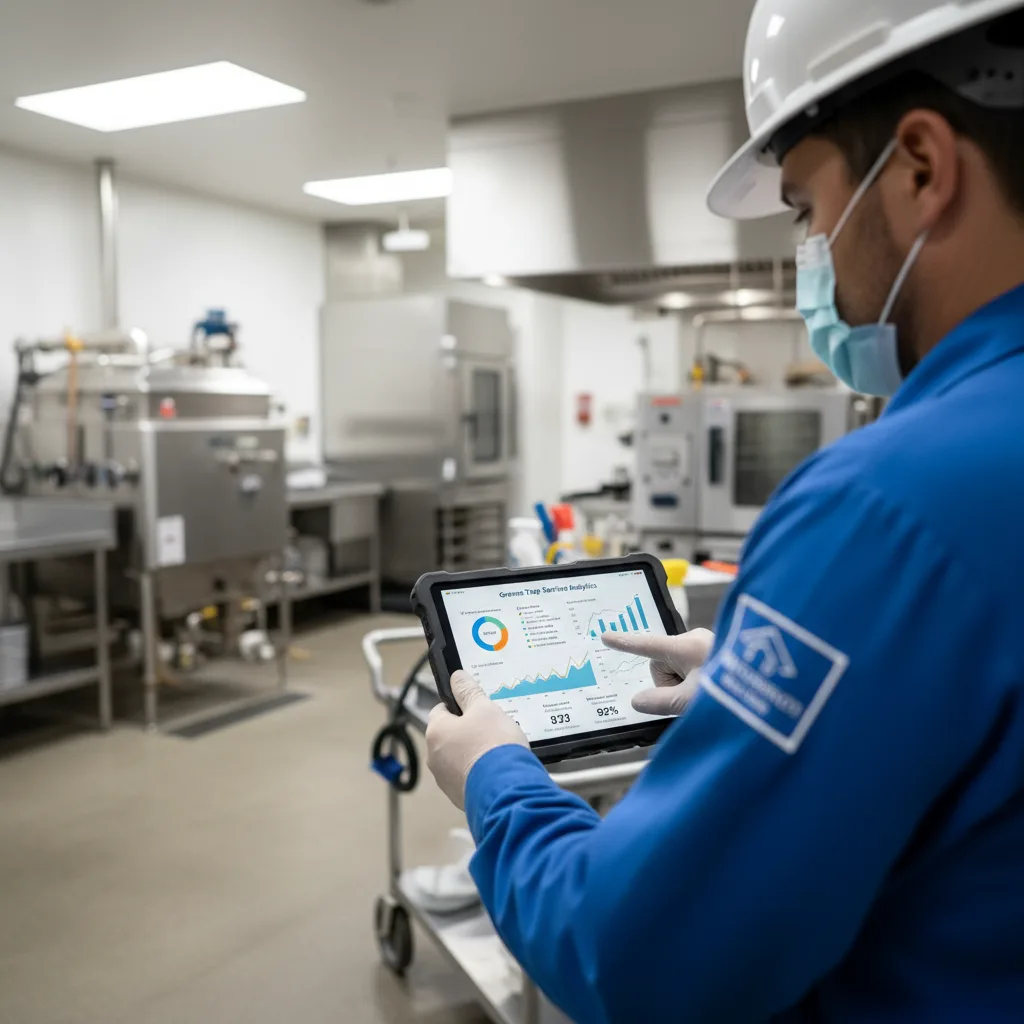
Choosing the right grease trap isn't about picking the cheapest option — it's about matching your kitchen's wastewater volume, cooking methods, and space constraints to a system that meets code and performs reliably. This guide breaks down the five most common types of grease traps used in commercial kitchens, helping you make an informed decision before installation day.
1. Passive Grease Traps (Traditional Flow-Through Units)
Passive grease traps — also called gravity grease interceptors — are the workhorses of commercial kitchens. These units rely on the simple principle that fats, oils, and grease (FOG) are lighter than water. As wastewater flows through the tank, FOG rises to the surface while solids settle to the bottom, allowing cleaner water to exit through an outlet baffle.
These systems range from compact 20-gallon units that fit under a three-compartment sink to massive 2,000-gallon in-ground interceptors serving entire food courts. The difference between a grease trap and a larger interceptor often comes down to capacity and installation location, but both use passive separation technology.
Passive traps work best when water temperature stays below 140°F at the inlet. Higher temperatures keep grease liquefied, reducing separation efficiency and leading to downstream clogs.
Most health departments require passive traps to be pumped when they reach 25% capacity — not when they're full. A 1,000-gallon interceptor needs service at 250 gallons of accumulated FOG, which typically happens every 30–90 days depending on kitchen volume. Restaurants with high-fat menus like fried chicken concepts or burger joints will hit that threshold faster than salad-focused cafés.
Installation costs vary widely. A small under-sink unit runs $800–$2,500 installed, while a 1,500-gallon outdoor interceptor can cost $8,000–$25,000 depending on excavation requirements and local labor rates.
2. Hydromechanical Grease Interceptors (HGIs)
Hydromechanical grease interceptors use internal baffles and venting systems to enhance FOG separation in a more compact footprint. Unlike passive traps that rely purely on detention time, HGIs create turbulence that speeds up the separation process, making them ideal for tight spaces where a traditional large-capacity trap won't fit.
These units typically handle 20–100 gallons per minute and are installed indoors, often in basements or utility closets. The compact design makes them popular in urban settings where outdoor ground space is limited or prohibitively expensive to excavate.
HGIs require more frequent maintenance than larger passive traps, but their smaller size often makes pumping faster and less expensive per service call.
The tradeoff is maintenance frequency. Because HGIs have smaller capacities relative to flow rates, they need pumping every 2–4 weeks in high-volume kitchens. A 50-gallon HGI serving a busy brunch restaurant might need service twice as often as a 500-gallon passive trap handling the same daily grease load.
Proper grease trap sizing is critical with HGIs. Undersizing leads to constant overflows and emergency service calls; oversizing wastes money upfront without improving performance.
3. Automatic Grease Recovery Units (AGRUs)
Automatic grease recovery units represent the premium end of grease management technology. These systems use mechanical skimmers, timers, and sometimes heating elements to automatically remove accumulated grease into a separate collection container — no manual pumping required for FOG removal, though solids still need periodic cleanout.
AGRUs shine in 24-hour operations like hotels, casinos, and hospitals where kitchen downtime for pumping disrupts operations. The units run automatic skim cycles — typically every 4–8 hours — transferring FOG to a sealed container that's swapped out weekly or biweekly.
The financial case for AGRUs depends on your operation's scale. A unit costs $15,000–$40,000 installed, but high-volume kitchens spending $800–$1,200 monthly on traditional trap pumping can see ROI in 18–36 months. Smaller operations rarely justify the upfront investment.
Maintenance requirements shift from pumping to mechanical upkeep. Motors, sensors, and skim arms need regular inspection and occasional part replacement. Many operators contract with the manufacturer or specialized service providers rather than relying on standard grease haulers.
4. Drawer-Style Grease Traps
Drawer-style traps mount directly under sinks or dishwashers, featuring a removable drawer that slides out for manual cleaning. These compact units typically hold 5–50 pounds of grease and are designed for low-volume applications or point-of-use protection.
You'll find drawer traps in coffee shops with minimal cooking, employee break rooms, or as supplementary protection for specific fixtures in larger kitchens. They're not rated for main kitchen discharge — health codes typically require larger capacity systems for three-compartment sinks and pot wash areas.
Drawer traps require staff to manually remove and clean the grease collection drawer every 1–7 days. If your team lacks the discipline for this routine, you'll face odor complaints and drain problems within weeks.
The advantage is cost and simplicity. A quality drawer trap costs $300–$1,200 installed — a fraction of larger systems. Cleaning takes 10–15 minutes and requires no special equipment beyond proper grease disposal containers and PPE.
The disadvantage is that they're labor-intensive and unsuitable for operations generating significant grease loads. A bakery frying donuts or a taqueria making carnitas will overwhelm even the largest drawer trap within hours.
5. Biological Grease Treatment Systems
Biological grease treatment systems use enzymes and bacteria to break down FOG before it enters the sanitary sewer. These units range from simple dosing systems that inject bacteria into existing traps to complete bioreactor units that replace traditional traps entirely.
The technology works — under the right conditions. Bacteria need warm temperatures (above 70°F), adequate oxygen, and time to digest grease. Systems that maintain these conditions can reduce FOG accumulation by 40–70%, extending time between pumpouts and potentially downsizing trap capacity requirements.
However, biological systems are not universally approved. Many municipalities prohibit them or require backup passive traps because biological treatment can fail if bacteria die off from temperature fluctuations, chemical sanitizers, or inadequate maintenance. Always check local codes before investing in biological treatment technology — what works in Phoenix may violate ordinances in Chicago.
If you pursue biological treatment, budget for monthly bacteria replenishment ($50–$200) and quarterly system inspections. Skipping maintenance causes rapid performance degradation and potential code violations.
Installation costs run $5,000–$15,000 for dosing systems added to existing traps, or $20,000–$50,000 for standalone bioreactor units. The ongoing cost of bacteria cultures and monitoring adds $600–$2,400 annually to operating expenses.
Choosing the Right Type for Your Operation
Your decision should factor in four variables: grease load, available space, budget, and staff capabilities. A complete understanding of how grease traps function helps clarify which type aligns with your operational reality.
High-volume kitchens with heavy frying operations need large-capacity passive traps or AGRUs. There's no workaround — the grease has to go somewhere, and undersized systems fail quickly. A 200-seat restaurant serving fried appetizers and entrées typically requires a minimum 1,000-gallon interceptor regardless of how appealing smaller systems look on paper.
Space-constrained urban locations often default to HGIs because excavating for a large outdoor interceptor costs more than the building's monthly rent. The tradeoff is accepting higher pumping frequency as a cost of doing business in dense environments.
Low-grease operations like juice bars, bakeries without fryers, or office break rooms can use drawer traps or small passive units — but only if staff reliably perform manual cleaning. One week of neglect creates problems that take months to fully resolve.
Budget considerations extend beyond purchase price. A $2,000 trap with $400 monthly pumping costs $6,800 in year one. A $15,000 AGRU with $150 monthly container service costs $16,800 in year one but may be cheaper over a five-year lifespan. Run total cost of ownership calculations, not just upfront price comparisons.
Frequently Asked Questions
What size grease trap do I need for a small restaurant?
Size depends on fixture units, not restaurant square footage or seat count. A typical small restaurant with a three-compartment sink, pre-rinse sink, and floor drains needs a 500–1,000 gallon passive trap or 40–75 GPM HGI. Your local plumbing inspector will calculate exact requirements based on the Uniform Plumbing Code or International Plumbing Code formulas during plan review.
Can I use a drawer trap as my primary grease trap?
Only for extremely low-grease applications like coffee bars or employee break rooms. Health departments require larger capacity traps for commercial cooking operations. Using an undersized drawer trap as a primary system violates code and leads to sewer backups, fines, and potential permit revocation.
How often do different types of grease traps need pumping?
Passive traps need pumping every 30–90 days depending on size and grease load. HGIs require service every 2–4 weeks. AGRUs need grease container swaps every 1–2 weeks but solids cleanout only quarterly. Drawer traps need manual cleaning every 1–7 days. Biological systems still require pumping, but intervals may extend 50–100% with proper maintenance.
Are automatic grease traps worth the extra cost?
For high-volume 24-hour operations spending over $600 monthly on trap pumping, AGRUs typically pay for themselves in 2–4 years while reducing service disruptions. For smaller restaurants open limited hours, the ROI rarely justifies the investment — stick with properly sized passive or hydromechanical systems.
What happens if I install the wrong type of grease trap?
Undersized traps overflow, sending grease into sewer lines and triggering violations that carry fines of $500–$5,000 per incident in most jurisdictions. Oversized traps cost more upfront without improving performance. Wrong trap placement violates plumbing code and fails inspection. Work with licensed plumbers and review plans with your health department before installation.
Selecting the right grease trap type protects your business from costly repairs, regulatory fines, and operational disruptions. When you're ready to install or upgrade your system, find verified grease trap services in your area at GreaseTrapLocator.com — connecting commercial kitchens with qualified professionals who understand local requirements and deliver reliable service.
Find verified, local contractors who handle cleaning, pumping, and FOG compliance — in your area.
