
Reviewed September 2026. | Read time: 8 min
Grease trap cleaning is a service business built on municipal rules and recurring demand. Restaurants and food-service operations are required by local pretreatment programs to keep their traps functioning — and most cannot or will not do it themselves. That creates a steady, contract-based revenue stream for licensed haulers.
This guide covers how to plan and launch a grease trap cleaning operation: what services to offer, what equipment and permits you need, how to build a disposal route, how to estimate your startup costs, and how to find your first customers. It is not a pitch — there are no guaranteed revenue figures here. What it does give you is the compliance-first framework that separates operators who last from those who get shut down.
Looking to hire a contractor instead? See cleaning costs & pricing or find contractors near you.
What a grease trap cleaning business actually does
A grease trap cleaning business pumps fats, oils, and grease (FOG) from interceptors installed at restaurants, cafeterias, hotels, hospitals, grocery stores, and other food-service operations. Most municipalities require these traps to be serviced on a schedule — typically every 30 to 90 days, or when the combined floating grease layer and settled solids reach 25% of the trap's total liquid depth (the "25% rule").
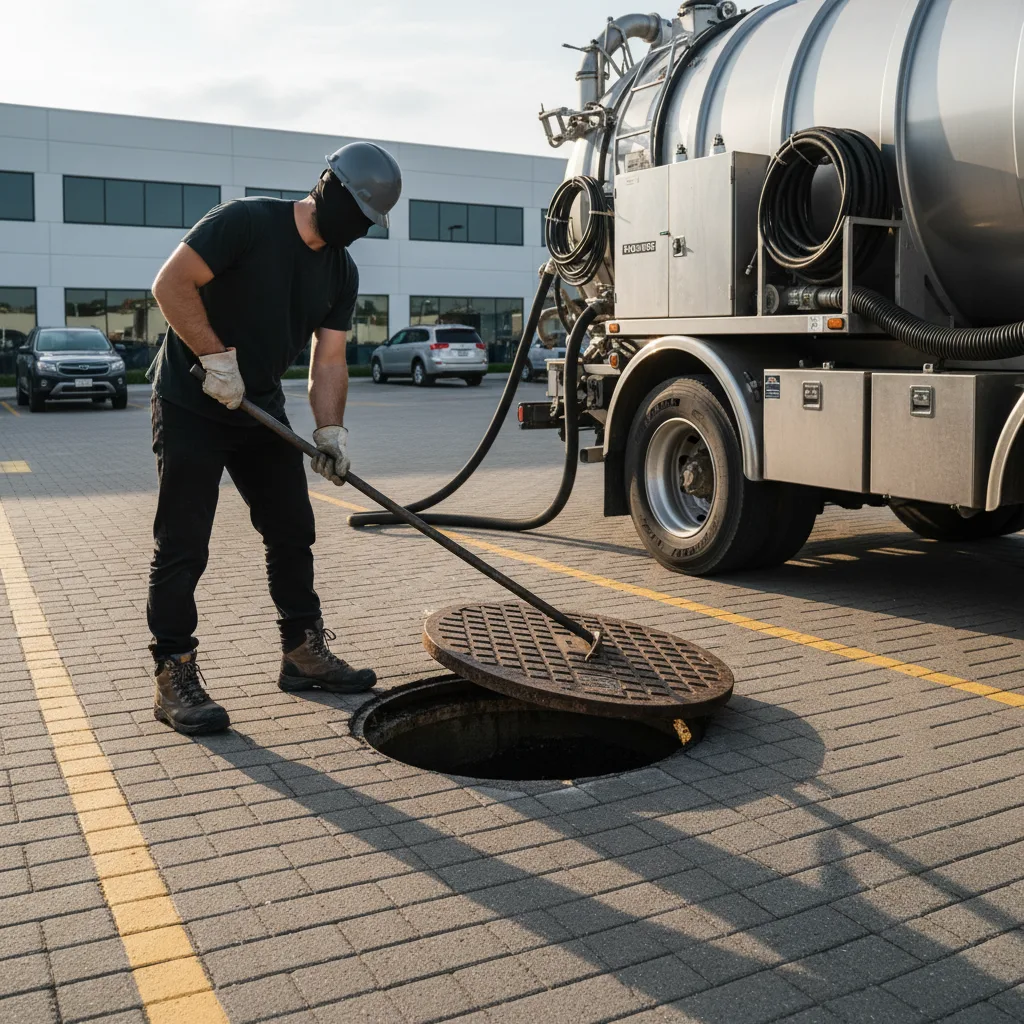
The work is straightforward: arrive with a vacuum truck, pump the trap, scrape the baffles, measure and document the waste volume, haul the material to an authorized receiving facility, and file the required manifests. A single-truck operator running a dense metro route can service 4 to 8 traps per day depending on trap sizes, access, and drive time.
Revenue comes from the cleaning fees. Contracts are typically recurring — monthly, bimonthly, or quarterly — which makes the business model more stable than one-time project work. What restaurants pay varies widely by location, trap size, and competitive density. Published procurement records from Tarrant County, Texas show bids of $190, $250, and $550 for the same 1,000-gallon service — see real contract figures in the cost guide.
1. Define the services you will actually offer
Separate cleaning and pump-out from waste transport, disposal, plumbing, repair, installation, excavation, electrical work, contaminated cleanup, and emergency response. Each activity changes the equipment, staffing, contracts, insurance, training, and legal checks required.
Most startup operators begin with cleaning and hauling only. Adding services like hydro-jetting, camera inspection, or grease-trap installation can come later once the base operation is running and properly licensed for each additional scope.
Write clear limits on what employees may do. Grease traps can expose workers to heavy covers, falls, gases, engulfment, traffic, moving vehicles, hot grease, biological material, and possible confined spaces. Do not design a service around entry into tanks or vaults without a compliant, competent safety program. OSHA's grease trap hazard alert covers the primary risks.
2. Map every authority and permission
License and permit requirements depend on the activity and location. Contact:
- Business-licensing office
- Wastewater or pretreatment program (the municipal authority that enforces FOG rules)
- Environmental or waste authority (state-level hauler registration)
- Vehicle and transportation regulators (CDL requirements, DOT if crossing state lines)
- Trade-licensing or building authority (if offering plumbing or installation)
Ask specifically about: transporter and vehicle registration, manifests or service records, acceptable receiving sites and waste streams, discharge prohibitions, plumbing or trade limits, storage, and spill response and reporting requirements.
Do not assume a rule from another city or state applies. A hauler permit valid in Houston does not cover Dallas. Some states require state-level waste transporter registration in addition to local permits. Start with your own municipality and work outward.
For a state-by-state overview of FOG regulations, see the GTL regulations directory.
3. Equipment: what you need and what it costs
The core equipment for a grease trap cleaning business is a vacuum truck with a debris tank, a pump, hoses, hand tools for trap access, and personal protective equipment.
Vacuum truck
This is the largest single expense. A used vacuum truck suitable for grease trap work (1,000 to 3,500 gallon tank) typically ranges from $25,000 to $80,000 depending on age, condition, tank size, and pump type. New purpose-built units start around $100,000 and can exceed $250,000 for larger configurations. Industry publications like Pumper magazine list current dealer inventories, and municipal surplus auctions occasionally offer decommissioned units.
Key specifications to match to your intended work:
- Tank capacity: match to the average trap sizes on your target route. A 1,500-gallon tank can service several standard under-sink traps before needing to dump; larger in-ground interceptors (1,000+ gallons each) may require a bigger truck or multiple trips.
- Pump type: rotary vane and sliding vane pumps are common for FOG work. Confirm the pump can handle the viscosity of cooled grease.
- Hose length and diameter: restaurant trap access varies. Some are in tight kitchen corners; others are buried in parking lots. Carry enough hose to reach.
- CDL requirement: depends on the vehicle's gross vehicle weight rating (GVWR) and your jurisdiction. Many grease trap trucks fall below the 26,001-lb CDL threshold, but verify with your state's motor-vehicle authority before purchasing.
Other startup equipment
- Hand tools: scrapers, scoops, measuring sticks (for documenting grease depth before and after)
- PPE: chemical-resistant gloves, eye protection, steel-toe boots, high-visibility vest. If any confined-space work is possible, the safety program and equipment requirements escalate significantly.
- Spill kit: absorbent materials, containment, cleanup supplies
- Documentation system: manifests, service reports, customer records. Some jurisdictions require specific manifest forms.
- Vehicle signage and DOT markings (if required)
What does it all cost?
There is no single startup number that applies everywhere. The truck is the largest variable. A conservative startup budget for a single-truck operation — including a used vacuum truck, equipment, insurance, licensing, and working capital — typically falls between $50,000 and $150,000. That range is wide because a $25,000 used truck in a low-permit-cost state is a different business than a $120,000 new truck in a state requiring specialized hauler bonds.
Build your own estimate from current written quotes for each line item. Section 5 below walks through the full cost model.
4. Prove the waste route before selling service
Identify authorized destinations that accept the material you intend to collect and confirm their current acceptance terms. Build a record trail from the customer site through transport and receiving. A generic statement that waste goes to a treatment plant is not enough; some facilities do not accept grease-trap waste, and acceptance terms (hours, testing, fees) change.
Disposal fees — what the receiving facility charges you, the hauler, per gallon or per load — are a recurring operating cost that directly affects your margins. Do not confuse facility tipping fees with the per-gallon rates contractors charge customers ($0.20 to $1.95 in published bids — that is revenue, not cost). Verify current disposal rates at your intended receiving facility before setting your service prices. See the profitability analysis for worked examples of how disposal costs affect margins.
Some operators also explore relationships with rendering companies by also collecting used cooking oil from restaurant fryers, which has resale value and can offset disposal costs. Learn more about cooking oil recycling.
5. Build the operating and financial model from quotes
Obtain written quotes for:
- Vehicles and tanks
- Maintenance and repair reserves
- Fuel (route-dependent — model actual miles)
- Receiving or disposal fees
- Safety equipment
- Insurance (commercial auto, general liability, pollution liability, workers' comp)
- Licensing and permit fees
- Communications (phone, GPS, scheduling software)
- Record and manifest systems
- Legal and accounting help
- Labor (if hiring)
- Training
- Parking and vehicle storage
- Backup capacity (what happens when the truck is down)
Model actual travel time, route density, facility access, downtime, seasonality, payment timing, and contract cancellations. A route with 6 stops averaging 45 minutes each plus 30-minute drive times is a full day before disposal time. Build from realistic service counts, not optimistic projections.
Research demand with interviews and public records where available. Avoid using broad national demand or profit claims as a substitute for a local customer and competitor study.
For a deeper look at the revenue side of the equation, see Is Grease Trap Cleaning Profitable?
6. Find your first customers
Your first customers will likely come from direct outreach to restaurants and food-service operations in your service area. Start with:
- Municipal FOG program lists: many pretreatment programs publish lists of permitted food-service establishments. These businesses are required to have their traps serviced — they are your market.
- Health department inspection records: restaurants cited for grease-related violations may be actively looking for a new service provider.
- Direct visits: walk into restaurants during off-peak hours (2–4 PM). Ask to speak with the owner or manager about their current grease trap service. Many operators are dissatisfied with their current provider's reliability or documentation.
- Property management companies: a single property manager may control 10–20 restaurant locations — one relationship, multiple contracts.
- Competitive gaps: underserved areas (rural, suburban, or routes other haulers avoid) often have less price pressure and more demand.
Once you have a few contracts running, build your online presence. Claim or create your free listing on directories like GreaseTrapLocator.com, set up a Google Business Profile, and make sure your phone number and service area are accurate. Restaurant managers increasingly search online when their current provider misses a pump-out.
For more on growing beyond the first contracts, see Grow Your Grease Trap Business.
7. Prepare written service controls
Use contracts or work orders that define:
- Equipment
- Scope
- Exclusions
- Access requirements
- Records and manifests
- Pricing and payment terms
- Additional-work approval process
- Incident handling
- Cancellation terms
Train staff to document the condition they observe without diagnosing plumbing or equipment work outside their competence.
For customer-facing checks, see How to Choose a Grease Trap Company. If considering a branded system, read the franchise due-diligence guide.
Frequently asked questions
How much does it cost to start a grease trap cleaning business?
A single-truck startup typically requires $50,000 to $150,000, depending primarily on whether you buy a used or new vacuum truck, your state's licensing and bonding requirements, and insurance costs. Build a local estimate from current written quotes — the range is too wide for a single number to be useful. See the equipment section above for a breakdown.
Is grease trap cleaning profitable?
It can be, but margins depend on route density, disposal costs, and local pricing. Published procurement bids show service fees ranging from $190 to $550 for a single 1,000-gallon cleaning. With operating costs (fuel, disposal, insurance, truck maintenance) deducted, per-service margins vary. See the full profitability analysis for worked examples.
Do I need a commercial driver's license?
It depends on the vehicle, configuration, weight, cargo, and jurisdiction. Many grease trap vacuum trucks fall below the 26,001-lb GVWR threshold for a CDL, but configurations with larger tanks or trailers may exceed it. Confirm the exact vehicle plan with the relevant motor-vehicle and transportation authorities before purchase or operation.
Can I dispose of grease trap waste at any wastewater plant?
No. Acceptance is facility- and waste-stream-specific. Some treatment plants do not accept hauled grease-trap waste at all. Confirm the current receiving location, authorization, hours, testing, documentation, and fees before offering collection.
How many customers do I need to cover my costs?
It depends entirely on your cost structure, pricing, and service frequency. As a rough framework: if you charge $250 per service and service each customer monthly, 20 regular customers would generate $5,000/month in gross revenue. Subtract fuel, disposal, insurance, truck payment, and your time to see what remains. Build this model with your actual numbers, not assumptions.
Should I offer plumbing repairs too?
Only after confirming the applicable trade license, permits, competent staff, insurance, tools, inspections, and responsibility. A cleaning or transport authorization does not automatically cover plumbing. Many operators start with cleaning only and add capabilities later.
What about used cooking oil collection?
Collecting used cooking oil from restaurant fryers is a related but separate business line. The equipment differs (smaller tank, oil-specific fittings), the waste stream is different, and the revenue model can include selling the collected oil to renderers. Some operators run both services on the same routes. See How a Used Cooking Oil Collection Business Works for the full breakdown.
Official sources
- U.S. SBA: Apply for licenses and permits
- U.S. EPA: National Pretreatment Program — Hauled Waste
- Florida DEP: Grease Waste
- OSHA: Grease Trap Hazards
- FMCSA: Commercial Driver's License
Are you a grease trap service provider? List your business on GreaseTrapLocator.com — it's free and puts you in front of restaurant owners searching for service in your area.

Author: Grease Trap Locator Editorial Team
The Grease Trap Locator editorial team covers FOG compliance, grease trap maintenance, and commercial kitchen regulations across the US and Canada. Our guides are written for restaurant owners, facility managers, and food service operators who need practical, accurate information without the fluff.
Find local contractors who handle cleaning, pumping, and FOG compliance — in your area.