
Prepared by GreaseTrapLocator · Fact review: August 9, 2026 · re-checked October 16, 2026
The purpose of grease interception
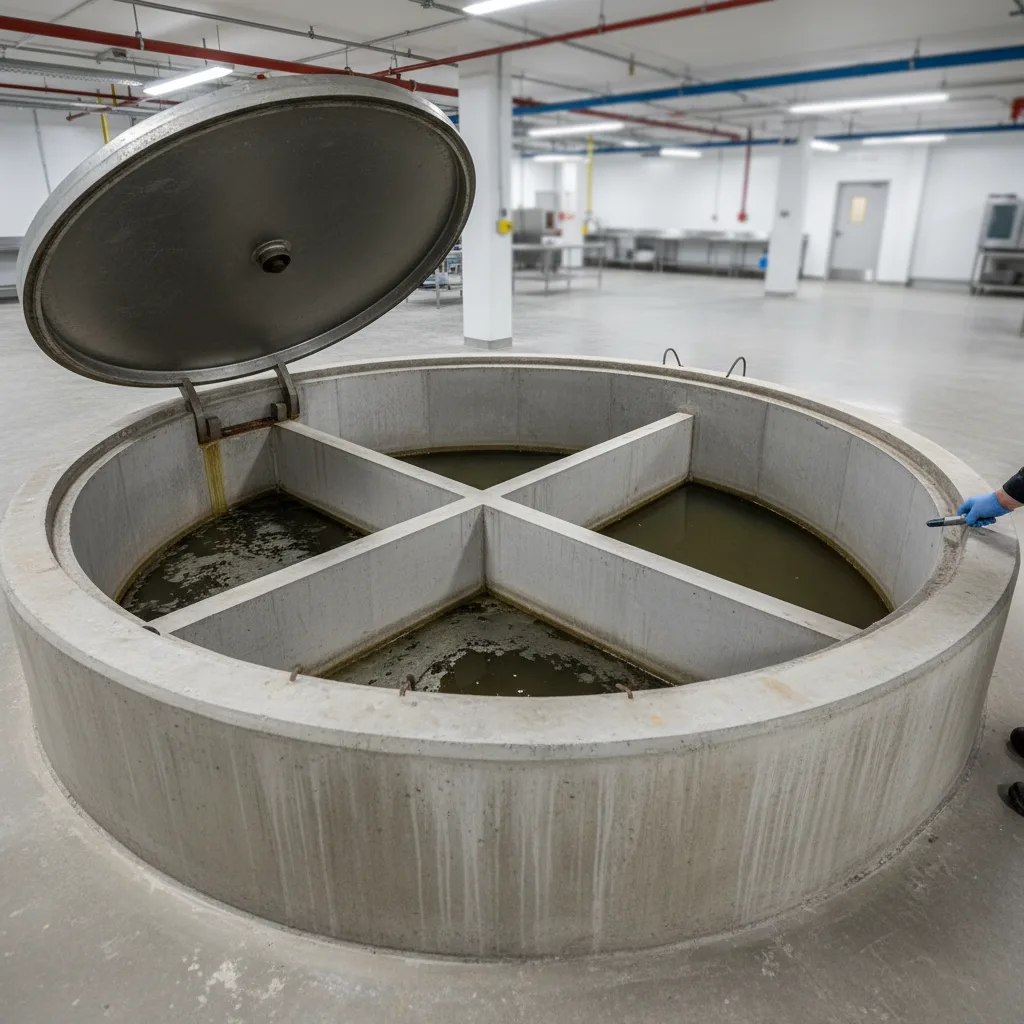
The U.S. Environmental Protection Agency explains that food-service establishments can use best-management practices and interceptor or collector devices to control and capture FOG before discharge to the public collection system. EPA also describes grease as a source of blockages because it can solidify, reduce conveyance capacity, and block flow.
For that reason, grease interception is about creating conditions for separation and capture before wastewater continues downstream. It is not a promise that every kind of FOG will be removed or that the water leaving a device is “clean.”
A simple way to picture the process
1. Wastewater reaches a control device
Food-preparation wastewater may carry water, FOG and solids. The equipment arrangement that serves a site must match the approved design and locally applicable requirements.
2. The equipment provides separation conditions
EPA says interceptor or collector devices should be designed and sized to allow FOG to cool and separate in a non-turbulent environment.
3. FOG is retained for removal
The purpose is to capture FOG on site rather than send it with wastewater into the public collection system. How a named device accomplishes that depends on its design and documentation.
4. The facility follows its actual requirements
Local wastewater or pretreatment requirements, approved plans, and current manufacturer instructions govern the particular installation and its care.
Why the device design matters
There is no one universal chamber layout, baffle arrangement, location, capacity, or performance percentage for every product called a grease trap or grease interceptor. The 2024 International Plumbing Code is a model code that uses the broader term grease interceptor for both gravity and hydromechanical forms. It becomes applicable only where a jurisdiction adopts it and may be changed by local amendments.
That distinction matters because a general diagram should explain a concept, not replace the instructions for a named model. The local authority and exact product documentation decide the installation arrangement, accepted connections, and project-specific requirements.
Why size and operating conditions still matter
EPA's FOG guidance says appropriate design and sizing are important for cooling and non-turbulent separation. It also says that required maintenance frequency depends greatly on the amount of FOG a facility generates and the best-management practices it implements.
Those statements support a practical next step: keep the local requirements, approved plans, fixture-routing information, operating conditions, and current manufacturer documentation together when reviewing the equipment. They do not justify a generic sizing formula, a fixed retention-time claim for every device, or a national cleaning calendar.
Use the right source for the right question
- What does the local program require? Ask the wastewater, pretreatment, plumbing, or building authority that controls the site.
- What did the project approve? Review the approved plans and the equipment arrangement shown for the facility.
- What does this model do? Read the current manufacturer listing, rating documents, installation instructions, and maintenance information for that exact model.
- Who should assess a problem? Use the site’s safety procedures and an appropriately qualified provider for the actual equipment and conditions.
This page intentionally does not give directions for opening, entering, chemically treating, or servicing equipment. Those activities require the current equipment instructions, the site's safety program, and the applicable authority's requirements.
Official sources used
U.S. Environmental Protection Agency — Controlling FOG Discharges
EPA describes FOG from food-preparation activities, blockage risk, on-site interceptor or collector devices, non-turbulent separation conditions, and facility/BMP-dependent maintenance frequency.
Read EPA FOG guidance · reviewed August 9, 2026
U.S. Environmental Protection Agency — Pretreatment Local Limits
EPA explains that local limits can be site-specific and can include numeric or narrative discharge limits and best-management practices.
Read EPA local-limits guidance · reviewed August 9, 2026
International Code Council — 2024 International Plumbing Code, Section 202
The model code defines gravity and hydromechanical forms under the grease-interceptor term.
Read the Section 202 definitions · reviewed August 9, 2026
Frequently asked questions
What does grease interception do?
Grease interception is intended to capture fats, oils and grease from food-preparation wastewater before it reaches the public collection system. EPA explains that appropriately designed and sized interceptor or collector devices allow FOG to cool and separate in a non-turbulent environment.
Does this explanation tell me what equipment my kitchen needs?
No. Equipment selection depends on the locally adopted requirements, approved project design, fixture routing, site conditions, and the exact product documentation. Everyday labels and a general explanation do not decide the approved equipment.
Does this page set a cleaning schedule or give service instructions?
No. EPA explains that maintenance frequency depends greatly on the amount of FOG a facility generates and the best-management practices it uses. Follow the current local wastewater or pretreatment program, approved project documents, and manufacturer instructions for the actual equipment.

Author: Grease Trap Locator Editorial Team
The Grease Trap Locator editorial team covers FOG compliance, grease trap maintenance, and commercial kitchen regulations across the US and Canada. Our guides are written for restaurant owners, facility managers, and food service operators who need practical, accurate information without the fluff.
Find local contractors who handle cleaning, pumping, and FOG compliance — in your area.