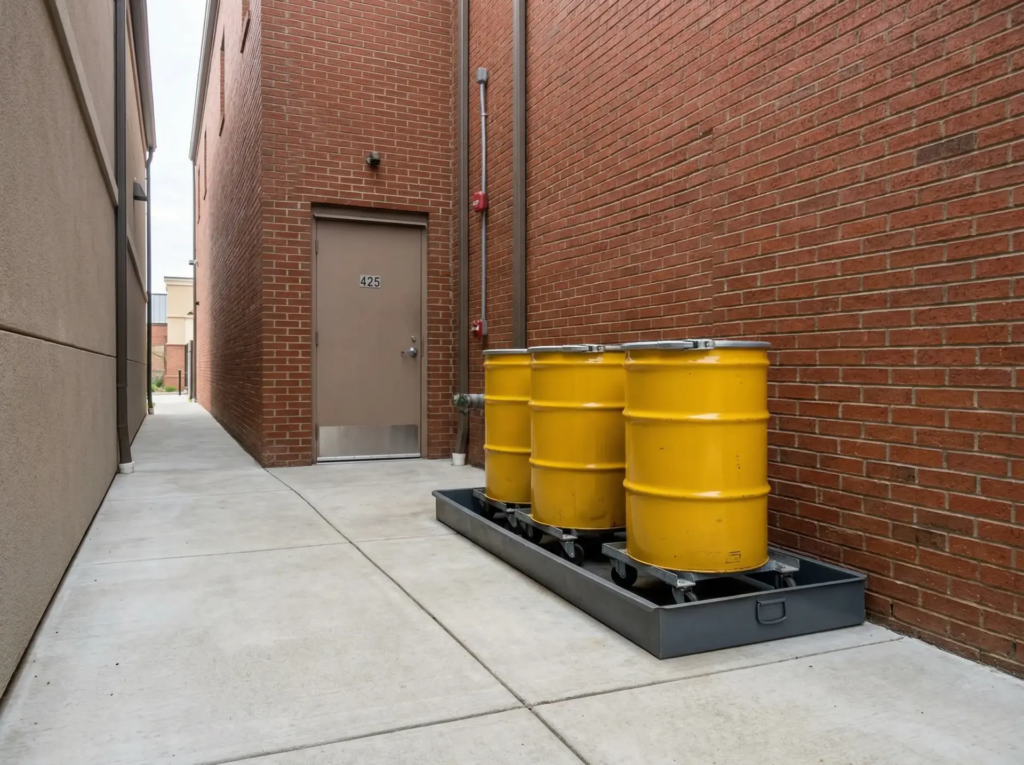

Commercial used cooking oil should be stored separately from grease-trap waste and handled through a collection or disposal route accepted for the location. Collection may be free, paid, or fee-based. The container, terms, records, and destination depend on the provider, oil quality, route, volume, and local rules.
Identify the material first
EPA describes yellow grease as used cooking oil and waste grease separated and collected at the point of use. Grease-trap waste is a separate category. Do not place trap contents, cleaning chemicals, wastewater, food, or packaging in a fryer-oil container. See yellow grease versus grease-trap waste for the authoritative site definition.
Set up storage and staff instructions
- Ask the collector and local authorities what container, location, labeling, locking, cover, and spill measures apply.
- Give staff a safe transfer method and clear accepted-material instructions.
- Keep the area accessible for authorized service and inspect for leaks, damage, or overflow risk.
- Record incidents and follow the site spill-response procedure.
Do not copy another city’s containment rule. Palo Alto, for example, has a local outdoor waste-oil secondary-containment requirement effective July 1, 2026. It demonstrates why location matters; it is not a national 110% containment rule.
Choose a collection arrangement
Ask prospective collectors to describe accepted oil, service area, container, pickup method, fees or rebates, measurement, records, contamination handling, spill response, contract term, cancellation, and final-container removal. Verify any locally required transporter or waste authorization directly with the authority.
A named provider's website or filing can establish its own service description, but not an industry-wide price, minimum volume, service interval, insurance amount, or contract term.
Can collection be free?
Yes, in some arrangements—but it is not guaranteed. NYC states that yellow grease is often collected free because it can be recycled. Hillsborough County’s residential cooking-oil program, by contrast, tells commercial and industrial customers to use a registered grease hauler. These are local examples, not national eligibility rules.
Commercial service may be free, paid, or fee-based depending on location, route economics, oil quality, volume, and the written provider agreement. No reliable national 25-, 30-, 35-, or 50-gallon threshold was found. Ask for the complete written terms, including container and service charges, rather than relying on “free pickup” alone.
Keep useful records
- Provider and authorization information checked for the location.
- Agreement, container ownership, and accepted-material instructions.
- Pickup date, weight or volume record when supplied, and any fee or rebate calculation.
- Contamination, missed service, spill, theft, damage, complaint, and corrective-action records.
- Local manifests or retention records where the named program requires them.
California’s inedible-kitchen-grease manifest is a state-specific example. It does not create a nationwide three-year restaurant record rule.
Where collected oil may go
EPA lists biogenic waste oils, fats, and greases as feedstocks in specified renewable-fuel pathways, and DOE explains that recycled cooking grease can be used to make biodiesel. A collector or processor may have other accepted uses. Do not promise biodiesel, animal feed, an 86% greenhouse-gas reduction, or zero landfill for every load unless the actual destination and lifecycle method are documented.
Household cooking oil
Household instructions vary. Alaska DEC, for example, says local options vary and permits less than one gallon of residential oil to be cooled, mixed with absorbent material, sealed, and put in household trash while listing local drop-offs. Never pour cooking oil down a sink, toilet, or storm drain, and confirm the option your local waste or recycling program offers.
Keep oil and grease out of drains
EPA’s food-service FOG fact sheet explains that grease poured into drains can solidify, reduce sewer capacity, and contribute to blockages and overflows. Fryer oil belongs in its collection container, not a sink, floor drain, or grease trap; local pretreatment programs set and enforce the specific rules for each facility.
Find a used cooking oil collector
GTL lists used cooking oil collection companies across the US and Canada. Start with your state or city, then compare written terms from more than one collector.
- All used cooking oil collectors
- California · Texas · Florida · New York
- Chicago · Houston
- Cooking oil recycling finder — search by location
Frequently asked questions
Is used cooking oil an EPA universal waste?
No. EPA's five federal categories are batteries, pesticides, mercury-containing equipment, lamps, and aerosol cans. State rules can add other materials, so location still matters.
Is cooking oil governed by EPA's petroleum used-oil rules?
Ordinary vegetable cooking oil is not the petroleum-based or synthetic lubricating oil described by that federal business guidance. Do not transfer those requirements to restaurant oil.
How often should used cooking oil be collected?
There is no reliable national interval. Set service from the actual container, generation, access, temperature, local requirements, and provider agreement, with enough margin to prevent overflow.
Do restaurants always get paid?
No. The agreement may be free, paid, or fee-based. Require the unit, measurement, adjustments, fees, and timing in writing.
General information only: This page is not legal, tax, environmental, safety, or business advice.
Sources
- U.S. EPA — Controlling FOG Discharges from Food Service Establishments
- U.S. EPA — Universal Waste
- U.S. EPA — Managing Used Oil for Businesses
- U.S. EPA — Approved Pathways for Renewable Fuel
- U.S. DOE — Biodiesel Production and Distribution
- NYC — Disposing of Grease as a Business
- Hillsborough County — Cooking Oil Recycling Effort
- Alaska DEC — Used Cooking Oil
- California CDFA — Inedible Kitchen Grease Manifest text
- City of Palo Alto — FOG Requirements for Food Facilities
Fact-checked August 15, 2026. Rules and commercial terms can change; recheck the named authority or provider before relying on them.

Author: Grease Trap Locator Editorial Team
The Grease Trap Locator editorial team covers FOG compliance, grease trap maintenance, and commercial kitchen regulations across the US and Canada. Our guides are written for restaurant owners, facility managers, and food service operators who need practical, accurate information without the fluff.
Find local contractors who handle cleaning, pumping, and FOG compliance — in your area.