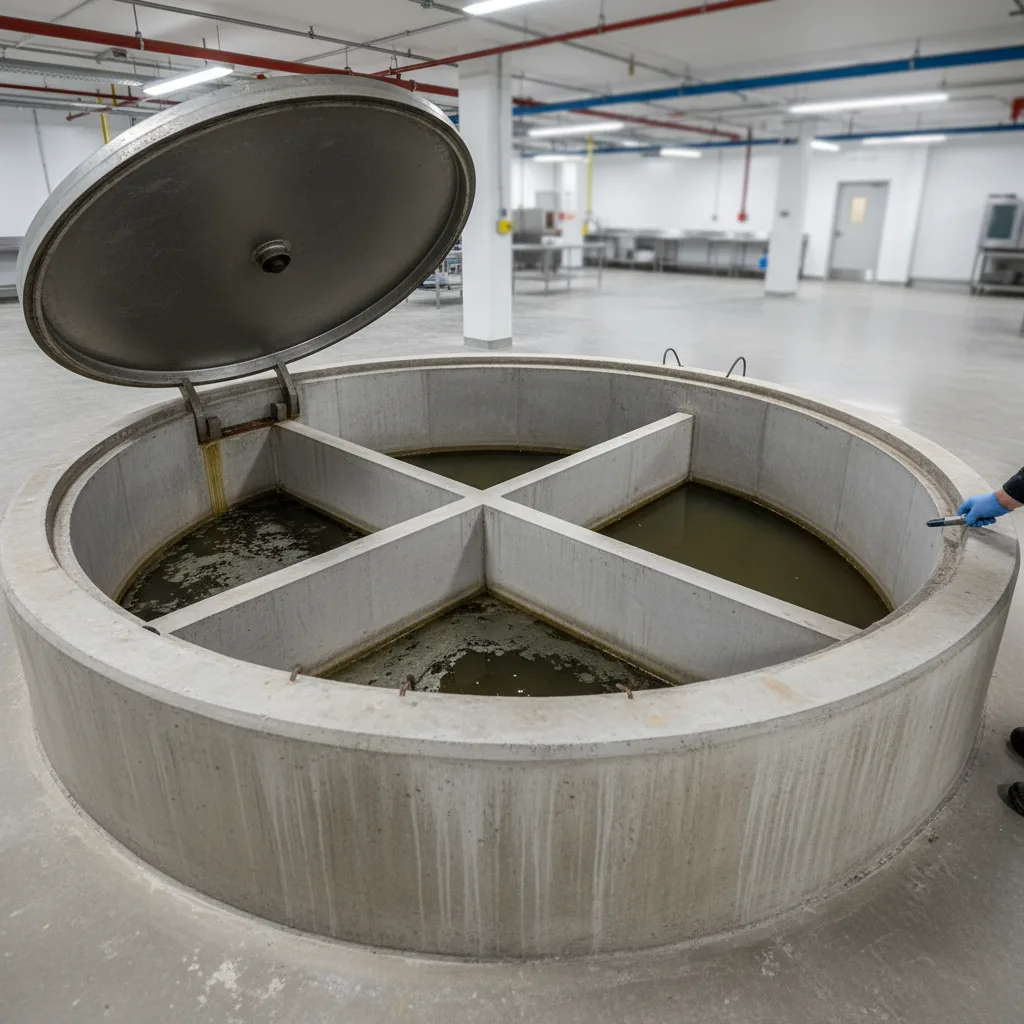

Every time a commercial kitchen washes a pan or rinses a fryer basket, fats, oils, and grease (FOG) flow toward the drain — and without intervention, they'd harden in your pipes and wreak havoc on municipal sewer systems. A grease trap is the silent workhorse that stops this from happening, using basic physics to separate FOG from wastewater before it leaves your building. Understanding exactly how this separation occurs helps you maintain the system properly and avoid costly backups.
The Core Principle: Gravity and Buoyancy
Grease traps operate on a deceptively simple principle: FOG weighs less than water. When greasy wastewater enters the trap and slows down, gravity pulls the heavier water and solid particles downward while the lighter fats and oils float to the surface. This natural separation occurs because grease trap devices are specifically designed to create the time and space needed for buoyancy to do its work.
The trap accomplishes this through three critical elements: a large holding capacity that reduces water velocity, baffles that force the flow downward and prevent turbulence, and adequate retention time — typically measured in how many minutes the wastewater remains in the tank. Most municipal codes require at least a one-minute retention time, though longer is often better for effective separation.
Temperature plays a supporting role. Hot water keeps fats liquefied as they enter the trap, but once inside the chamber, they begin cooling. As the temperature drops, the FOG solidifies and floats in a distinct layer at the top of the tank, making eventual removal more straightforward.
Anatomy of a Grease Trap: How the Components Work Together
A standard passive grease trap contains four main zones, each serving a specific function in the separation process. The inlet receives wastewater from your kitchen fixtures and immediately forces the flow downward through an inlet baffle — a vertical barrier that extends below the water surface. This baffle serves two purposes: it prevents incoming turbulence from stirring up the FOG layer already floating at the top, and it directs the flow to the bottom of the tank where solids can settle.
The separation chamber is where the magic happens. This is the largest zone in the trap, designed to hold enough volume that water velocity drops to nearly zero. Without movement, FOG rises unimpeded to form a floating layer while food solids sink to form a sediment layer at the bottom. The middle zone contains relatively clear water — the "gray water" that will eventually exit to the sewer.
The retention time inside a properly sized grease trap is what transforms chaotic, grease-laden wastewater into three distinct layers that can be managed separately.
The outlet baffle sits near the far end of the tank, also extending below the water surface. It creates a submerged pathway for the middle layer of clean water to exit while blocking both the floating FOG above and the settled solids below. This design ensures that only the relatively clean middle layer flows into your building's drainage system and eventually to the municipal sewer.
Finally, the access port at the top of the unit allows service technicians to pump out accumulated FOG and solids during regular maintenance visits. Without this regular removal, the trap would eventually fill with waste and lose its separation capacity entirely.
The Flow Path: Following Wastewater Through the System
When you understand the journey wastewater takes through a grease trap, maintenance requirements start making more sense. The process begins when greasy water from sinks, dishwashers, or floor drains enters the trap through the inlet pipe. The flow immediately hits the inlet baffle and is forced downward, losing velocity as it enters the larger chamber.
As the flow rate decreases, the separation process begins. Lighter FOG particles start their upward migration while heavier food particles drop toward the bottom. The wastewater spreads horizontally across the chamber, maximizing the time available for this separation to occur. This horizontal flow pattern is why trap sizing matters so much — a tank that's too small forces water through too quickly, not allowing adequate time for FOG to separate.
Calculate your required trap size based on fixture unit load and local code requirements. Under-sizing is the most common installation error and leads to poor separation efficiency and frequent backups.
As new wastewater continuously enters, it displaces an equal volume at the outlet end. The outlet baffle skims water from the middle zone — the cleanest layer — and directs it into the outlet pipe. This submerged outlet design is crucial: if the outlet were at the surface, it would simply allow the FOG layer to flow straight through without any separation occurring.
The system maintains a constant water level through this displacement principle. As long as wastewater keeps entering, effluent keeps exiting, but the FOG and solids remain trapped inside the chamber where they accumulate until the next pumping service.
Why Passive Separation Has Limits
Traditional passive grease traps work well for many applications, but they have inherent limitations that facility managers should understand. The separation process depends entirely on the density difference between FOG and water, which means emulsified grease — fats broken into tiny droplets by hot water and detergents — won't separate effectively. These microscopic particles stay suspended in the water and pass right through the trap.
This is why using minimal detergent in kitchen sinks matters. Commercial dish detergents are specifically designed to emulsify grease, which is great for getting dishes clean but terrible for grease trap performance. The more emulsified your FOG becomes, the less effective gravity separation will be.
Never pour boiling water or strong degreasers down drains connected to your grease trap. These create emulsions that bypass the separation process and contribute to downstream sewer blockages.
Temperature fluctuations also affect performance. If wastewater enters too hot, FOG remains liquefied and may not separate before exiting the trap. If ambient temperatures drop significantly — common in outdoor interceptor installations — solidified grease can become so thick it impedes flow entirely. Some operations in cold climates require heated grease traps to maintain proper function year-round.
The efficiency of passive separation also degrades as the trap fills. When the FOG layer grows too thick, it encroaches on the middle zone where clean water should be, forcing the outlet baffle to draw from increasingly contaminated water. Similarly, excessive solids buildup at the bottom reduces the effective volume of the separation chamber. This is why the 25% rule exists: most jurisdictions require pumping when the combined FOG and solids layers reach 25% of the total tank capacity.
Active vs. Passive Systems: Different Mechanisms
While traditional grease traps rely purely on gravity, some facilities use active systems that enhance separation through mechanical means. Automatic grease removal devices incorporate skimmers, heaters, or air injection systems to improve FOG capture rates and extend service intervals.
These systems work by accelerating or enhancing the natural separation process. Air injection systems introduce fine bubbles that attach to FOG particles and carry them to the surface faster than gravity alone. Mechanical skimmers continuously remove the FOG layer as it forms, preventing the accumulation that limits passive trap capacity. Some units include sensors that monitor FOG levels and alert managers when service is needed.
The core physics remains the same — FOG still separates based on density — but active systems optimize conditions for separation and removal. They're particularly valuable in high-volume operations where passive traps would require impractically frequent pumping, though they come with higher installation costs and ongoing maintenance requirements for the mechanical components.
Common Failures in the Separation Process
Understanding how grease traps work also means recognizing what happens when they don't. The most frequent failure mode is simple overflow — when FOG and solids accumulate faster than they're removed, eventually filling the entire chamber. At this point, incoming wastewater has no clear zone to draw from, and grease flows directly into the sewer system.
Baffle damage is another critical failure point. If the inlet or outlet baffle cracks or corrodes, it no longer properly directs flow through the separation chamber. Wastewater may short-circuit directly from inlet to outlet, bypassing the separation zone entirely. Regular inspections should always include checking baffle integrity.
Undersized traps create a permanent operational problem. If your trap was sized for lower flow rates than your kitchen actually produces, water moves through too quickly for effective separation regardless of how often you pump it. The only real solution is replacement with a properly sized unit — a costly fix that emphasizes the importance of correct initial sizing.
Frequently Asked Questions
How long does it take for grease to separate in a trap?
Most grease traps are designed for a minimum one-minute retention time, though effective separation typically requires 2-5 minutes depending on water temperature and FOG concentration. This is why trap sizing calculations include flow rate — the tank must be large enough that wastewater spends adequate time inside for buoyancy to separate the FOG layer. Faster flow rates require larger tank volumes to maintain proper retention time.
Can a grease trap work without baffles?
No. Baffles are essential to the separation process. Without an inlet baffle, incoming flow would create turbulence that mixes the FOG layer back into the water. Without an outlet baffle, the floating grease layer would flow directly into the outlet pipe. Some older or damaged traps have corroded baffles, which explains poor performance even when the trap is regularly pumped.
Do grease traps work for all types of fats and oils?
Grease traps work best with non-emulsified fats and oils that retain their density difference from water. They struggle with emulsified grease (broken into tiny droplets by detergents), certain synthetic oils, and dairy fats that behave differently than cooking oils. Animal fats typically separate well when allowed to cool, while vegetable oils may remain partially liquid even at lower temperatures.
Why does my grease trap smell if it's working properly?
Even a functioning grease trap will develop odors as trapped FOG and food solids decompose through bacterial action. The anaerobic conditions inside the trap produce hydrogen sulfide and other sulfur compounds that create the characteristic rotten egg smell. This is normal and doesn't indicate failure, though excessive odor may signal the trap needs pumping or that you need more frequent service intervals.
What happens to grease trap efficiency in cold weather?
Cold temperatures cause FOG to solidify more quickly, which can actually improve separation initially. However, if temperatures drop too low, the solidified grease layer becomes extremely thick and viscous, potentially blocking flow or making pumping difficult. Outdoor interceptors in cold climates may need insulation or heating elements to maintain proper function during winter months.
The science behind grease trap operation is straightforward — density separation through gravity — but effective performance depends on proper sizing, installation, and maintenance. When all components work together and service intervals match your kitchen's FOG production, the system reliably protects both your plumbing and the municipal sewer infrastructure. Ready to ensure your grease management system is working at peak efficiency? Find grease trap services in your area for professional installation, maintenance, and compliance support.

Author: Grease Trap Locator Editorial Team
The Grease Trap Locator editorial team covers FOG compliance, grease trap maintenance, and commercial kitchen regulations across the US and Canada. Our guides are written for restaurant owners, facility managers, and food service operators who need practical, accurate information without the fluff.
Find local contractors who handle cleaning, pumping, and FOG compliance — in your area.