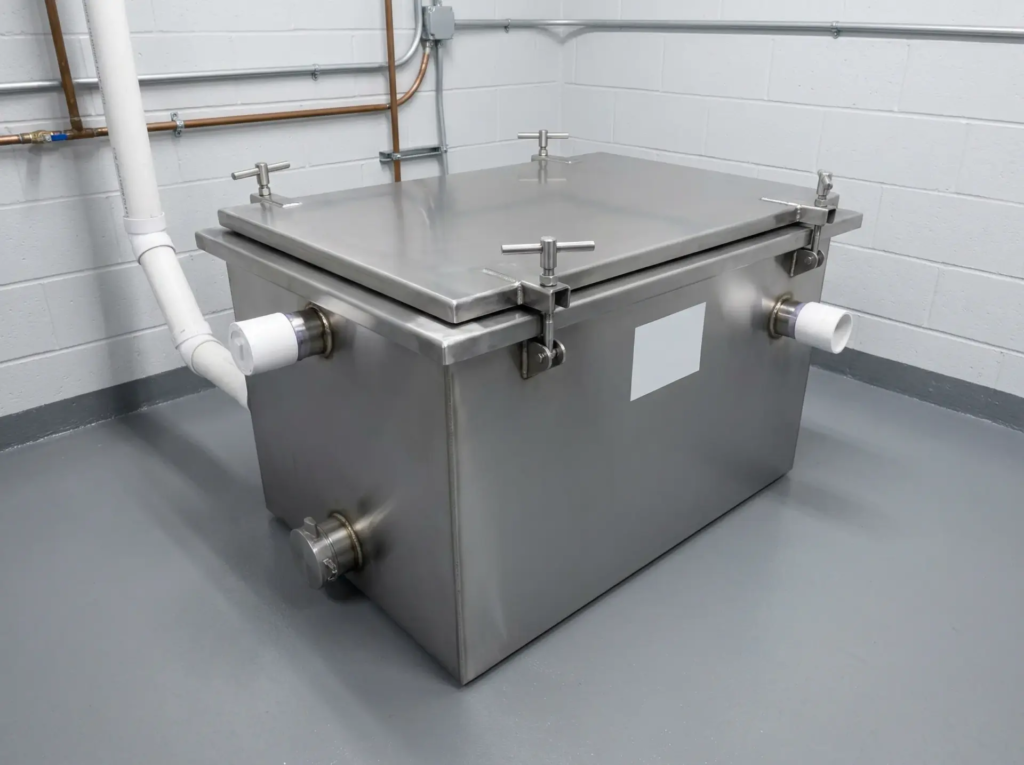

If you operate a commercial kitchen — restaurant, cafeteria, hotel, food processing facility — you have a grease trap. You're required to. And if it fails, so does your kitchen. This guide covers everything a responsible operator needs to know: how grease traps work, which type is right for your operation, how often to clean them, what compliance actually requires, and how to find a qualified contractor when you need one.
Grease trap management isn't glamorous, but it's one of the few operational tasks that can shut you down overnight if you ignore it. Municipalities across North America issue notices of violation, impose fines, and require emergency pump-outs when traps fail. Understanding the basics keeps you ahead of that problem.
What Is a Grease Trap and Why Does It Matter?
A grease trap — also called a grease interceptor or FOG interceptor — is a plumbing device installed in the drain line of a commercial kitchen. Its function is to capture fats, oils, and grease (FOG) before they reach the municipal sewer system.
FOG is the enemy of wastewater infrastructure. When grease enters the sewer system, it cools, solidifies, and accumulates on pipe walls. Over time this creates blockages that cause sewer overflows. Industry estimates suggest FOG contributes to roughly half of all sewer overflows in the United States.
The grease trap intercepts this before it becomes the city's problem. When it works correctly, you stay compliant, your drains flow, and your municipality stays off your doorstep. When it doesn't, the consequences range from foul odors in your kitchen to full operational shutdown.
Understanding your grease trap is basic facility management for any food service operator. For a foundational overview, see what is a grease trap.
How Grease Traps Work: The Physics Behind FOG Separation
Grease traps operate on a straightforward physical principle: grease is less dense than water, so it floats. The trap slows wastewater flow and allows cooling, which causes FOG to solidify and rise to the surface while food solids sink to the bottom. The cleaner middle layer — effluent — flows out to the sewer.

The key to effective separation is retention time — how long wastewater sits in the trap before exiting. Many municipal codes require a minimum retention time of 30 minutes. This is why sizing matters: an undersized trap doesn't give FOG enough time to separate, and grease passes straight through into the sewer line.
Most grease traps include inlet and outlet baffles to prevent short-circuiting of flow, and a vented lid to allow gas escape. As the trap fills with accumulated FOG and solids, available volume for separation decreases — which is why cleaning frequency is tied directly to fill level, not a fixed calendar schedule.
Types of Grease Traps: Which One Fits Your Operation?
There are three main categories of grease interceptors used in commercial food service. Each suits a different scale of operation.

Hydromechanical Grease Interceptors (HGIs)
Also called passive grease traps, these are the most common type — typically installed under the sink or in a floor pit near kitchen fixtures. They're compact, relatively inexpensive, and effective for smaller operations with lower daily FOG output. The tradeoff: these units fill quickly and require service every one to four weeks depending on kitchen volume.
Gravity Grease Interceptors (GGIs)
Large concrete or fiberglass tanks installed underground outside the building. These handle high-volume operations — large restaurants, hotels, schools, food processing facilities. Because of their size, they require less frequent cleaning, typically quarterly, though this varies by jurisdiction and fill rate. Installation requires excavation and represents a significant capital investment, but long-term maintenance cost per gallon of FOG captured is lower than smaller units.
Automatic Grease Removal Units (AGRUs)
Mechanized systems that use a skimming mechanism to remove accumulated grease into a separate container automatically. These reduce the frequency of professional pump-outs but still require regular monitoring and maintenance. Appropriate for operations that generate consistent FOG volume and want to minimize service disruptions.
Choosing the right type comes down to your kitchen's daily flow rate, available space, local code requirements, and your operational tolerance for maintenance frequency. A licensed plumber or FOG contractor can assess your specific situation.
How to Size a Grease Trap Correctly
Undersizing is the most common grease trap mistake. An undersized interceptor can't achieve adequate retention time, so FOG passes through — leaving you non-compliant even though equipment is present and functioning.
“An undersized trap is worse than no trap — it fills faster, overflows sooner, and puts you in violation before your next scheduled service.”
Sizing is determined by your kitchen's maximum flow rate (gallons per minute) and required retention time. Most local codes define the sizing formula; your local building department or wastewater utility will have the applicable standard. Common reference standards include PDI G101 for hydromechanical interceptors and ASME A112.14.3.
In practice: the larger your dishwashing capacity, the number of sinks, and overall water use in your kitchen, the larger your required interceptor. Codes often apply a multiplier for grease-heavy operations such as fried food restaurants versus coffee shops or light delis.
If you're opening a new location or retrofitting an existing space, have your sizing reviewed by a licensed plumber familiar with your local FOG ordinance before purchasing equipment. Replacing an undersized trap after installation is expensive.
Cleaning and Maintenance: Frequency, Records, and Costs
The industry standard threshold for cleaning is 25% capacity — when FOG and solids together occupy 25% of the trap's volume, it should be serviced. Beyond that threshold, FOG begins bypassing the interceptor and entering the sewer line.
In practice, cleaning frequency ranges from weekly to quarterly depending on trap type and kitchen volume. High-volume operations with under-sink HGIs may need service every one to two weeks. Large outdoor gravity interceptors may only need quarterly pump-outs. Some jurisdictions mandate minimum cleaning frequencies regardless of fill level — check your local ordinance.
Keep service records. Most municipalities that conduct inspections require a cleaning log — typically the manifest from your licensed hauler. If you can't produce documentation of recent service, that alone can trigger a violation. For a full maintenance program, see the grease trap maintenance guide. For frequency specifics, see how often to clean a grease trap. For pricing by region and trap size, see the grease trap cleaning cost guide.
FOG Compliance: What Your Municipality Actually Requires
Nearly all municipalities with active wastewater systems require commercial food service operators to install, maintain, and document grease interceptor service. Requirements vary significantly by jurisdiction, but common elements include:
Missing a scheduled service visit is not just a maintenance issue — it can trigger fines, reinspection fees, and in repeat cases, temporary closure orders. Keep service records for at least 3 years.
- A permit to operate a grease interceptor, issued by the local wastewater authority
- Required cleaning frequency — minimum service intervals, often quarterly or when 25% full
- Licensed hauler requirements — waste must be disposed of by a permitted waste hauler
- Manifest documentation — signed records of each service visit, retained for inspection
- Periodic inspection by the wastewater utility
Violations typically result in written notices, fines, and required corrective action. Repeat violations can escalate to permit suspension or forced closure. The trend over the past decade has been toward more active FOG enforcement programs, not less. For a detailed breakdown by jurisdiction, see the FOG compliance guide.
Finding a Qualified Grease Trap Service Contractor
Not all grease trap service companies are equal. Using an unlicensed hauler can expose you legally — if they don't properly manifest and dispose of the waste, the liability can fall back on you as the generator.
Always ask contractors for a copy of the waste manifest after each service. This document proves legal disposal and is your primary protection during a municipal inspection.
When evaluating contractors, confirm:
- Current waste hauler permit issued by your state environmental agency
- Signed manifests provided with each service — required for your compliance records
- Capability to service your specific trap type and size
- Verifiable operating history in your service area
Markets like Dallas, TX have multiple licensed operators — but in smaller or rural markets, options are more limited. Verifying credentials before you're in an emergency situation saves time and risk. For a full vetting checklist, see how to choose a grease trap company.
What to Do in a Grease Trap Emergency
When a grease trap fails — backup into the kitchen, overflow, or sudden odor surge — the response matters. Shutting off water flow to the affected fixtures, documenting the situation, and contacting a licensed emergency service are the immediate priorities. Operating through a sewage backup creates health code violations separate from FOG compliance. For a step-by-step emergency response guide, see the grease trap emergency guide.
Frequently Asked Questions
How often does a grease trap need to be cleaned?
The standard threshold is when FOG and solids reach 25% of the trap's total capacity. In practice, this means cleaning every one to four weeks for high-volume operations with small under-sink traps, or every one to three months for large outdoor gravity interceptors. Some jurisdictions set mandatory minimum frequencies regardless of fill level — check your local FOG ordinance for requirements specific to your area.
Is a grease trap legally required for restaurants?
In nearly all U.S. and Canadian municipalities, yes. Any commercial food service operation discharging to the municipal sewer system is typically required to install a grease interceptor and maintain service records. Requirements are enforced by local wastewater authorities, so inspections may come from a different agency than your food service permit.
What is the difference between a grease trap and a grease interceptor?
The terms are often used interchangeably, but technically "grease trap" tends to refer to smaller hydromechanical units installed under sinks or in floor pits, while "grease interceptor" more often refers to larger gravity-fed tanks installed outdoors underground. Both serve the same function — capturing FOG before it reaches the sewer — but differ significantly in size, capacity, and maintenance requirements.
What happens if I don't clean my grease trap?
FOG bypasses the trap and enters the sewer line. Downstream, this causes blockages in your lateral line and in the municipal sewer system. Operationally, you'll experience slow drains, sewage odors in the kitchen, and eventually backups. From a compliance standpoint, inspectors can issue notices of violation, assess fines, and require emergency pump-outs — often at significantly higher cost than routine service.
How do I find a licensed grease trap contractor in my area?
Look for companies with current waste hauler permits issued by your state environmental agency. They should provide signed manifests at every service visit — this is your compliance documentation. Grease Trap Locator lists grease trap contractors across North America, searchable by location. Find licensed contractors near you at greasetraplocator.com.
Find verified grease trap contractors in your area — Search the Grease Trap Locator directory

Author: Grease Trap Locator Editorial Team
The Grease Trap Locator editorial team covers FOG compliance, grease trap maintenance, and commercial kitchen regulations across the US and Canada. Our guides are written for restaurant owners, facility managers, and food service operators who need practical, accurate information without the fluff.
Find local contractors who handle cleaning, pumping, and FOG compliance — in your area.