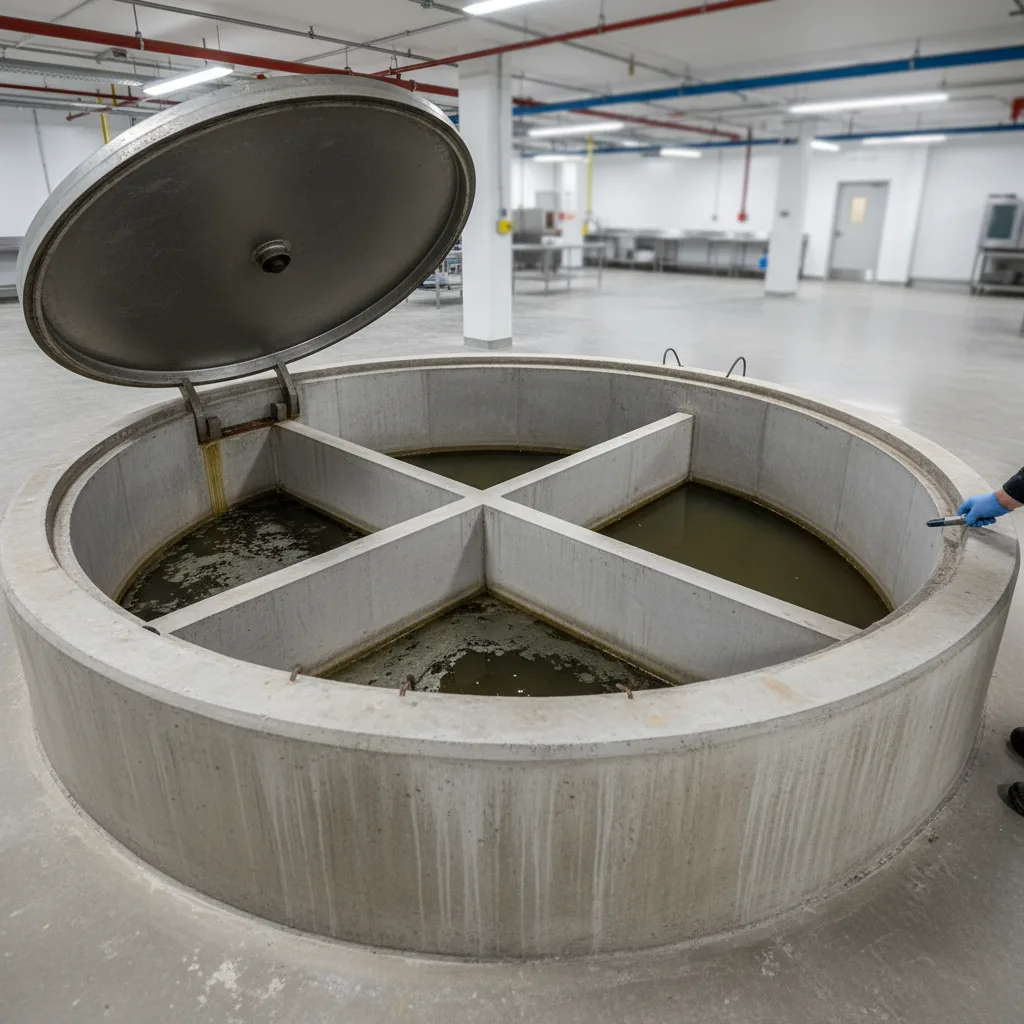
A 1000 gallon grease trap handles 100–200 gallons per minute and costs between $4,000–$8,000 installed, making it the most common choice for full-service restaurants with 150–300 seats. Choosing the wrong size creates compliance violations, overflows, and emergency pump-outs that cost 3–5 times more than scheduled maintenance. This guide shows you how to match grease trap capacity to your kitchen's flow rate, compare 100 to 1500 gallon options, and avoid the sizing mistakes that trigger health department red flags.
How Grease Trap Sizing Works
Grease trap sizing depends on three measurements: the flow rate from your kitchen fixtures (measured in gallons per minute), the grease retention capacity (measured in pounds), and the holding period required by local codes (typically 30–90 minutes). The trap must slow wastewater enough to separate fats, oils, and grease (FOG) before discharge into the sewer system.
Most jurisdictions use the Uniform Plumbing Code formula: required capacity (gallons) equals fixture flow rate (GPM) multiplied by retention time (minutes) divided by 60, then multiplied by a storage factor between 1.5 and 2.0. A kitchen with 100 GPM flow and a 30-minute retention requirement needs a minimum 750 gallon trap with a 1.5 storage factor — which puts you in 1000 gallon territory after accounting for grease storage volume.
The trap's grease capacity (measured in pounds) matters more than its liquid volume for operational performance. A 1000 gallon grease trap typically holds 500–750 pounds of separated grease before requiring pump-out. When grease accumulates beyond 25% of the trap's total liquid depth, separation efficiency drops sharply and FOG begins passing through to the sewer.
Request a flow rate calculation from your plumbing contractor before selecting a trap size. Guessing based on square footage or seat count leads to undersized installations that fail inspections.
Flow rate calculations require measuring every fixture that drains into the trap: three-compartment sinks, dishwashers, floor drains, prep sinks, and mop sinks. Each fixture has a drainage fixture unit (DFU) value — a 50-seat restaurant typically generates 80–120 DFUs, which translates to 40–60 GPM. Double those numbers for high-volume operations with multiple dish machines and you reach the 100+ GPM threshold where 1000 gallon traps become necessary.
Comparing 100 to 1500 Gallon Grease Trap Sizes
A 100 gallon grease trap serves small cafes, coffee shops, and concession stands with minimal food preparation — think operations with one or two sinks and no dishwasher. These traps handle 10–20 GPM and cost $800–$2,000 installed. They require pump-out every 2–4 weeks because their 50–75 pound grease capacity fills quickly.
A 500 gallon grease trap fits small to mid-size restaurants with 50–100 seats, handling 40–60 GPM. Installation costs run $2,500–$5,000. These traps hold 250–350 pounds of grease and typically need service every 4–8 weeks depending on cooking volume and menu type. Quick-service restaurants with heavy fryer use hit the upper limit of 500 gallon capacity — you'll see them on pump-out schedules every 3–4 weeks.
The difference between a 500 and 1000 gallon trap isn't just capacity — it's the difference between weekly emergencies and predictable maintenance schedules.
The 1000 gallon grease trap represents the workhorse category for full-service restaurants, hotel kitchens, hospital cafeterias, and institutional food service. With 100–200 GPM capacity and 500–750 pounds of grease storage, these traps support 150–300 seat operations running breakfast, lunch, and dinner services. Pump-out intervals extend to 6–12 weeks for most operators, and installation costs range from $4,000–$8,000 depending on burial depth and site conditions.
A 1500 gallon grease trap handles the highest-volume commercial kitchens: large hotels with multiple restaurants, casino food courts, shopping mall food service clusters, and institutional kitchens serving 500+ meals daily. These traps process 200–300 GPM and store 800–1,200 pounds of separated grease. Installation costs start at $8,000 and climb past $15,000 for complex sites requiring excavation below the water table or near existing utilities.
The jump from one size category to the next isn't gradual — it's a threshold determined by your kitchen's peak flow rate. Running a 500 gallon trap on a kitchen designed for 1000 gallons doesn't save money. It doubles your pump-out frequency, increases odor complaints, accelerates wear on baffles and components, and creates the conditions for FOG discharge violations that carry $1,000–$5,000 fines per incident.
When You Need a 1000 Gallon Grease Trap
Your operation needs a 1000 gallon grease trap when peak flow calculations exceed 90 GPM or when you're running multiple high-output fixtures simultaneously. This includes restaurants with two or more three-compartment sinks, commercial dishwashers processing 150+ racks daily, and prep areas with floor drains receiving indirect waste from steamers, kettles, and combination ovens.
Menu type matters as much as seat count. A 150-seat restaurant serving fried foods requires larger grease capacity than a 200-seat operation focused on grilled items and salads. Breakfast concepts using griddles and flat-tops generate different FOG profiles than dinner houses running char-broilers. Calculate based on actual grease production, not dining room size.
Multi-tenant buildings and shared kitchen facilities almost always require 1000 gallon or larger traps. When three restaurants share a grease interceptor, you're combining their flow rates — a 40 GPM operation plus two 30 GPM neighbors equals 100 GPM total, pushing you into 1000 gallon territory even though each individual tenant might operate below that threshold independently.
Install a trap one size larger than minimum code requirements if your concept includes plans for future expansion, patio dining additions, or menu changes toward higher-grease items. Upsizing during initial installation costs 40–60% less than replacement three years later.
Jurisdiction matters significantly. California, New York, and Florida enforce stricter sizing requirements than many other states — their codes often mandate 50% larger capacity than the basic UPC formula. Nevada and Texas allow more flexibility but require professional engineer certification for installations serving 100+ seats. Always verify local requirements before finalizing your trap selection, as variance applications add 4–8 weeks to your timeline.
Installation and Maintenance Considerations by Size
A 1000 gallon grease trap measures approximately 8 feet long by 4 feet wide by 5 feet deep and weighs 2,000–3,000 pounds empty. Installation requires excavation to 6–7 feet below grade in most cases, accounting for inlet/outlet pipe elevations and minimum soil cover. Concrete pads, backfill specifications, and traffic-rated covers add $1,500–$3,000 to installation costs beyond the trap itself.
Smaller 100 and 500 gallon traps offer installation advantages in tight urban locations or buildings with limited outdoor space. Some 500 gallon models fit in basement mechanical rooms or under parking areas where larger traps won't work. But indoor installations require additional venting, access panels meeting fire code, and secondary containment that can negate the space-saving benefits.
Pump-out logistics change with trap size. A 100 gallon trap costs $150–$250 per service but requires 18–24 annual visits. A 1000 gallon trap costs $400–$600 per pump-out but needs only 4–8 annual services. Total annual maintenance costs often equalize across sizes, but larger traps provide schedule predictability that prevents emergency callouts during peak service periods.
Installing a trap smaller than code requirements voids your certificate of occupancy and creates liability if a sewer backup damages neighboring properties. Insurance claims for grease-related backups are routinely denied when undersized traps are discovered.
Access and service clearances differ by manufacturer but generally require 3–4 feet of clear space around all manhole covers. The 1000 gallon category typically uses two or three access points — one over the inlet baffle, one at the outlet, and sometimes a center access for large-capacity models. Parking vehicles over access covers or building permanent structures within clearance zones creates code violations and complicates emergency service.
Cost Analysis: Material, Installation, and Long-Term Operating Expenses
Material costs for grease traps follow a non-linear pricing curve. A basic 100 gallon unit costs $600–$1,200 for the trap itself. A 500 gallon model runs $1,800–$3,500. The 1000 gallon category ranges from $3,200–$6,000 depending on features like high-capacity baffles, sampling ports, and corrosion-resistant coatings. Premium manufacturers with lifetime warranties add 25–40% to material costs but eliminate replacement expenses over 20–30 year service lives.
Installation labor represents 40–60% of total project cost for traps 500 gallons and larger. Excavation, shoring, concrete work, and utility coordination drive these expenses. Urban sites with restricted access for excavators and dump trucks can double installation costs compared to suburban locations with open yard space. Expect $2,500–$5,000 in labor for a typical 1000 gallon installation under normal conditions.
Operating costs over five years tell the real story. A 100 gallon trap at $200 per pump-out, serviced 20 times annually, costs $20,000 in maintenance alone. A 1000 gallon trap at $500 per service, pumped 6 times yearly, costs $15,000 over the same period. Factor in the higher initial investment and the larger trap still delivers lower total cost of ownership for operations that genuinely need the capacity.
Permit fees vary wildly by jurisdiction — some municipalities charge flat $200–$500 fees while others assess permits based on trap capacity at $2–$5 per gallon. A 1000 gallon installation might carry a $2,000–$5,000 permit in high-cost jurisdictions. Budget 8–12 weeks for permit approval in major metro areas, less in smaller municipalities with streamlined processes.
Frequently Asked Questions
How much does a 1000 gallon grease trap cost installed?
A 1000 gallon grease trap costs $4,000–$8,000 installed, including the trap unit ($3,200–$6,000), excavation and labor ($1,500–$3,500), and permits ($200–$2,000). Urban sites with difficult access or deep burial requirements can reach $10,000–$12,000 total. Premium models with lifetime warranties add $1,000–$2,000 to material costs but eliminate future replacement expenses.
How often does a 1000 gallon grease trap need pumping?
A 1000 gallon grease trap requires pump-out every 6–8 weeks for most full-service restaurants operating at design capacity. High-volume operations with extensive fryer use may need service every 4–6 weeks, while lower-grease concepts can extend to 10–12 weeks. Most jurisdictions require pump-out before grease and solids exceed 25% of total liquid depth regardless of time interval.
What size restaurant needs a 1000 gallon grease trap?
A 1000 gallon grease trap serves restaurants with 150–300 seats, hotel kitchens, institutional cafeterias, and operations generating 100–200 gallons per minute peak flow. The trap size depends on fixture count and flow rate, not just dining room capacity. Multiple dish machines, three-compartment sinks, and floor drains receiving indirect waste from cooking equipment all contribute to the 100+ GPM threshold requiring this capacity.
Can I use a smaller grease trap to save money?
Installing an undersized grease trap violates plumbing codes, fails inspections, and creates liability for sewer backups affecting neighboring properties. Undersized traps require pump-out 2–3 times more frequently, increasing annual maintenance costs by $3,000–$6,000. The initial savings of $2,000–$4,000 disappear within the first year of operation while creating compliance violations that carry $1,000–$5,000 fines per incident.
How long does a 1000 gallon grease trap last?
A properly maintained 1000 gallon grease trap lasts 20–30 years with quality construction and regular servicing. Fiberglass and polyethylene models outlast concrete in corrosive environments. Steel traps require coating maintenance every 5–7 years to prevent corrosion. Neglecting pump-out schedules accelerates deterioration of baffles and internal components, reducing service life to 10–15 years and creating premature replacement costs of $8,000–$12,000.
Selecting the right grease trap size prevents the cycle of emergency pump-outs, compliance violations, and premature equipment failure that plague undersized installations. Whether you're opening a new concept or replacing a failing trap, matching capacity to actual flow rate and grease production delivers predictable maintenance schedules and long-term cost control. For detailed guidance on specific applications and local code requirements, explore our comprehensive resources in the grease trap knowledge base.
Find verified grease trap services in your area at https://www.greasetraplocator.com.
Find verified, local contractors who handle cleaning, pumping, and FOG compliance — in your area.
