
Prepared by GreaseTrapLocator · Fact review: August 9, 2026
This is a guide to reading three current manufacturer product records. It is not a stainless-steel, plastic, or concrete comparison, and it does not recommend a product or material for a restaurant. Each fact below belongs only to the named model and the linked record. The records use different product fields and do not establish a ranking, a conversion, or a selection rule.
What a product document can—and cannot—answer
A manufacturer’s product page can identify the construction, rating fields, configuration options, and documents for one named product. It does not establish that every interceptor made from a similar material has the same features, warranty, operating limits, or local approval. A warranty also describes limited terms and conditions; it is not a prediction of how long a product will remain in service.
Document record: Schier GB-250-B
Schier identifies the GB-250-B as a grease interceptor rotationally molded from high-density polyethylene. Its current product record lists 75 GPM, 1,560 pounds at 99%, and 277 gallons of liquid capacity, and identifies indoor/outdoor installation locations. These are GB-250-B facts only. [1] See our Schier Great Basin review for all current models.
Schier’s lifetime warranty applies to its grease-interceptor products at the original installation location and configuration. The warranty excludes, among other things, wear and tear, extreme temperatures, and pH levels; it also requires installation under Schier’s instructions and applicable building and plumbing codes. This is a warranty condition record, not a service-life guarantee or a warranty for polyethylene interceptors generally. [2]
Document record: Watts WD-50
Watts identifies the named WD-50 base product as an epoxy-coated steel grease interceptor. Its current record lists a 50-GPM flow rate and says the base product can be recessed or floor mounted. The same record lists all-stainless-steel construction as an available option. It does not identify a separate all-stainless WD-50 ordering configuration or a material grade in the record reviewed here. [3]
Watts says that its product warranties are often unique to a product or product family. Its published standard limited warranty states one year for defects in material and workmanship under normal usage, subject to its stated conditions and limitations. The reviewed WD-50 record does not expressly say that this standard warranty is the WD-50’s applicable warranty. Treat the published text as a warranty record to verify for the exact ordered configuration—not as a WD-50-specific warranty finding. [4]
Document record: E.C. Babbert G-2
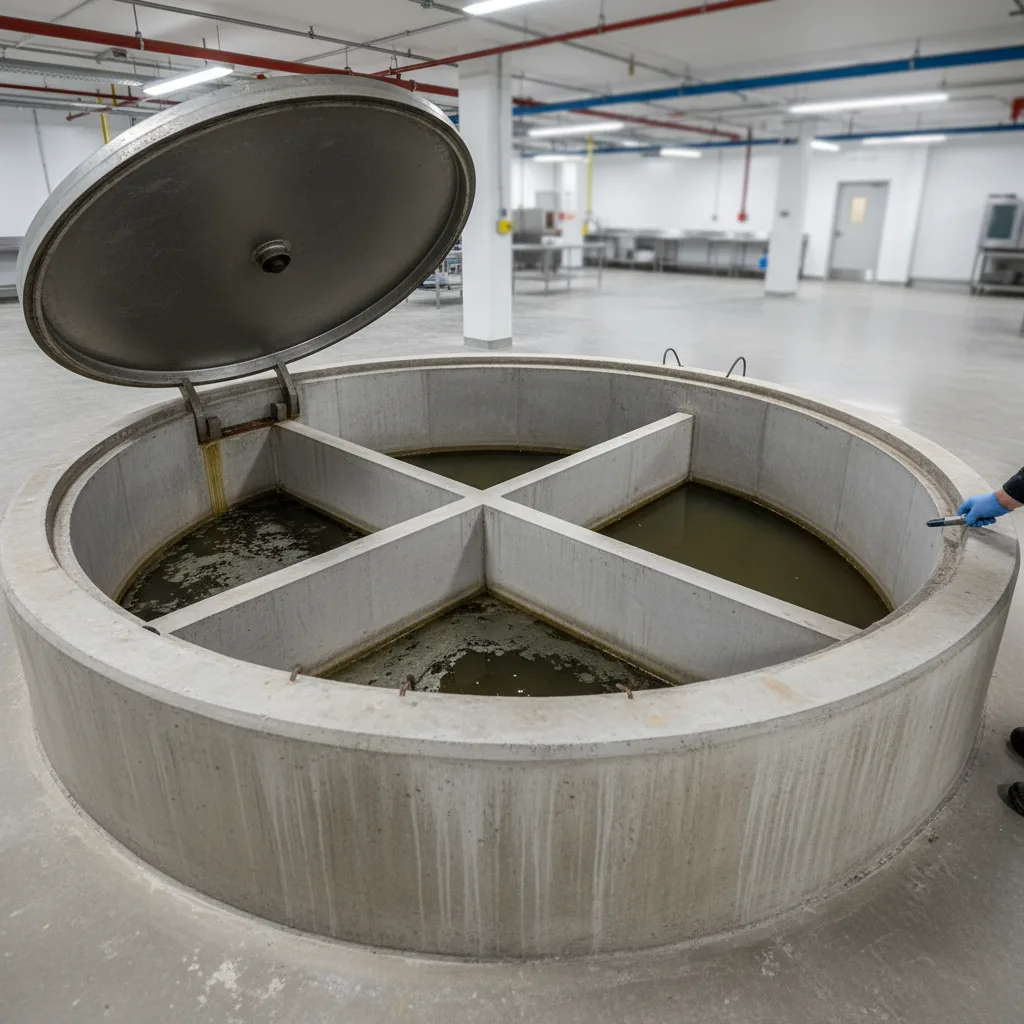
E.C. Babbert identifies the G-2 as a model in its precast-concrete grease-interceptor line. The product page gives a grease-retention capacity of 560 pounds, or 9.9 cubic feet, and says the authority with jurisdiction determines the required interceptor size. Its drawing index lists a Model G-2 Grease Interceptor drawing. These statements concern the named manufacturer record; they are not a concrete-material rule or a sizing method for another project. [5] [6]
The G-2 product page and drawing index reviewed for this guide do not display a written warranty. That is a limit of the document set reviewed here; it does not establish that no warranty exists. Do not infer warranty coverage, expected service life, maintenance needs, or a performance advantage from that absence.
What these records do not establish
These three records do not establish which material is best, expected service life, price, cleaning frequency, chemical or temperature suitability, odor or sanitation outcome, restaurant-type suitability, installation method, or local approval. They also do not make the different rating fields interchangeable. Product and site decisions need the complete current documents for the exact proposed configuration and the controlling local approval process.
Before treating product documents as comparable
For any proposed product, first obtain the exact ordering configuration, the full current manufacturer specification or installation document, the written warranty that applies to that configuration, and the local authority’s decision for the project. The three records above show why a product page, an option listing, or a general warranty page alone may not answer all of those questions.
Frequently asked questions
Do these records show that one grease-interceptor material is better than another?
No. They record facts for three named manufacturer products and do not make a material-wide comparison or recommendation.
Does the Watts WD-50 record identify a stainless-steel model?
No. The reviewed WD-50 record identifies the base product as epoxy-coated steel and lists all-stainless-steel construction as an option. It does not identify a separate all-stainless ordering configuration or material grade. [3]
Does a published warranty state how long a grease interceptor will last?
No. A warranty states limited terms and conditions. Schier’s warranty applies at the original location and configuration and includes stated exclusions; Watts says its warranty terms can differ by product or product family. Neither point is a service-life estimate. [2][4]
Does the absence of a written G-2 warranty in these sources mean that no warranty exists?
No. It means that the E.C. Babbert G-2 product page and drawing index reviewed for this guide do not display a written warranty. Confirm the applicable warranty for the exact product directly before relying on warranty coverage. [5][6]
Can this page choose a grease interceptor for a restaurant?
No. This page does not select equipment, convert product rating fields, or state a local approval rule. Use the complete documents for the exact proposed configuration and the controlling local approval process.
Sources
- Schier Products, “GB-250-B” (current product page verified August 9, 2026). Named-model facts only.
- Schier Products, “Lifetime Warranty” (current warranty page verified August 9, 2026). Schier grease-interceptor warranty terms and exclusions only.
- Watts, “WD-50” (current product page verified August 9, 2026). Named base-product and listed-option facts only.
- Watts, “Warranty Information” (current warranty page verified August 9, 2026). Published general standard-warranty terms; verify application to the exact product/configuration.
- E.C. Babbert, “G-2 Grease Interceptors” (current product page verified August 9, 2026). Named-model facts only; manufacturer marketing conclusions are not used.
- E.C. Babbert, “Product Drawings” (current drawing index verified August 9, 2026). Shows the listed Model G-2 drawing only.

Author: Grease Trap Locator Editorial Team
The Grease Trap Locator editorial team covers FOG compliance, grease trap maintenance, and commercial kitchen regulations across the US and Canada. Our guides are written for restaurant owners, facility managers, and food service operators who need practical, accurate information without the fluff.
Find local contractors who handle cleaning, pumping, and FOG compliance — in your area.