
Reviewed August 9, 2026 · Local wastewater requirements and approved project documents control what applies at a facility.
What this overview can—and cannot—tell you
FOG control is a wastewater-management issue, not a single nationwide product or maintenance recipe. In the United States, federal pretreatment rules prohibit discharges that cause Pass Through or Interference, as those terms are defined in the rules. They also prohibit solid or viscous pollutants in amounts that obstruct flow in a publicly owned treatment works and result in Interference. They also allow wastewater utilities to establish local limits and best management practices. Those local limits are site-specific.
That is why this page does not assign a device type, size, service interval, percentage trigger, price, or permit requirement to every kitchen. Those details must come from the wastewater authority serving the address, the locally adopted plumbing requirements, approved plans, and the documentation for the equipment actually installed.
A practical way to organize the work
1. Identify the controlling program
Find the wastewater utility, pretreatment program, or local authority that governs the facility. Save the rule, guidance, permit, approval, and any written direction that applies to the address.
2. Confirm the installed equipment
Use the exact manufacturer, model, rating, installation record, and approved connection information. Do not treat gallons, flow ratings, grease-retention ratings, or retention time as interchangeable measurements.
3. Keep the required records
Follow the local program’s requirements for service documentation, disposal records, or other evidence. If the kitchen or equipment changes, ask whether the approval or operating requirements also need to change.
4. Use the right safety process
This page does not authorize opening a cover, probing a device, entering a pit or tank, or performing service. Follow current equipment instructions, property rules, employer safety procedures, and qualified service guidance.
Why broad equipment shortcuts do not hold up
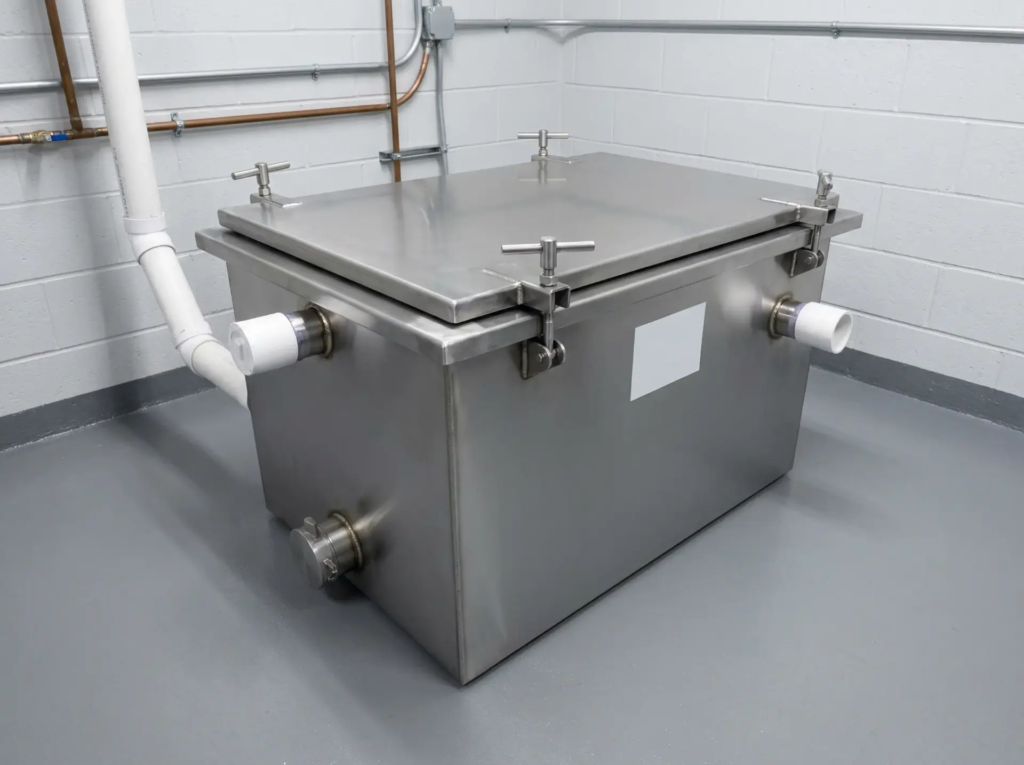
Terms and configurations can overlap. A current manufacturer example illustrates the limitation: Schier’s GB2-C is a named 35-GPM product described for under-sink use, but its product page also describes above-grade and below-grade installation options. Its GB-1000 is a named 1,000-gallon product described for indoor or outdoor and above-grade or buried configurations, with both hydromechanical and gravity certifications. Those facts are about those models only; they are not a sizing rule for another facility.
Keep each GTL guide in its lane
This page is a short overview. For a focused explanation of separation principles, see how grease control devices work. For food-preparation sources, federal context, and source-control planning, see FOG explained. For terminology and an equipment-selection process, see the comparisons: grease interceptor vs. grease trap and grease trap vs. grease interceptor.
Questions to take to the local program
- Which authority governs the facility’s wastewater discharge and grease-control requirements?
- What device, connection, location, sizing method, approval, and documentation apply to this address?
- What written requirement controls service timing, records, disposal, and changes to kitchen use or equipment?
- Who may perform the work under the local program, property rules, and the equipment instructions?
Frequently asked questions
Does every commercial kitchen need the same grease-control equipment?
No. The controlling requirements depend on the local wastewater authority, locally adopted plumbing rules, approved plans, and the actual facility. Federal pretreatment rules do not prescribe one device for every commercial kitchen.
Is there one national maintenance schedule or percentage trigger?
No. EPA says maintenance frequency depends greatly on the amount of FOG a facility generates and its best management practices. Local wastewater programs can set site-specific limits and requirements.
Can this page determine what size or location is required?
No. A device’s rating, liquid capacity, location, connected fixtures, installation, and approval must be confirmed through the local authority, approved project documents, and current manufacturer documentation for the exact model.
Can staff use this guide to open or service an interceptor?
No. This overview does not authorize opening, entering, or servicing a grease-control device. Employers must evaluate workplaces for applicable hazards, and work must follow the local program, property rules, current equipment instructions, and qualified safety procedures.
Official sources reviewed

Author: Grease Trap Locator Editorial Team
The Grease Trap Locator editorial team covers FOG compliance, grease trap maintenance, and commercial kitchen regulations across the US and Canada. Our guides are written for restaurant owners, facility managers, and food service operators who need practical, accurate information without the fluff.
Find local contractors who handle cleaning, pumping, and FOG compliance — in your area.