
Grease Trap Installation Cost: Published Price Examples
The City of Tampa says the average install for a small grease trap (0–100 gallons) is $250–$1,500, and the average installation of a new 750–1,500-gallon grease trap is $4,000–$8,500. Use named examples like these as reference points, then build your budget from written proposals.
What these published prices cover
Tampa's utility FAQ publishes local installation examples. They are Tampa examples, not national quotes or guarantees.
Schier publishes 2026 wholesale list prices for its named products. List prices are for the equipment only, before freight, tax and installation, and are not a buyer-specific quote; permits, plumbing, excavation, and restoration are extra or may differ.
Drain-Net publishes prices for named monitoring products. One provider's listings are not a complete monitoring market survey or installed price.
Read the transcript
Restaurant owner: So… what’s this going to cost?
Narrator: That depends. Here are three things that can change it.
Narrator: One: size. It can change the pumping and disposal work.
Narrator: Two: how full it is, and how long it’s been.
Restaurant owner: …It’s been a while.
Narrator: Hardened grease can take longer to clear.
Narrator: Three: access. How easy it is to reach.
Narrator: Find grease trap services near you on GreaseTrapLocator, and contact them directly.
On screen: Find grease trap services near you. greasetraplocator.com. Free to use.
Build an itemized installation bid
- Approved manufacturer, model, rating, accessories, freight, and warranty.
- Plumbing, venting, testing, and connections.
- Excavation, utilities, shoring, base, backfill, risers, lids, and traffic loading.
- Electrical, alarm, or monitoring work.
- Design, plan review, permits, and inspections.
- Demolition, temporary service, access, business interruption, and restoration.
Let the local authority control the design
The serving authority sets the binding equipment and approval requirements. A model code, manufacturer sheet, or another city's example does not approve a design for this property.
Published Cost Examples
The following figures are published examples with named sources. They are not national averages and do not replace a site-specific quote.
| Source | Published example | What it does not include or prove |
|---|---|---|
| City of Tampa utility FAQ | Average install $250–$1,500 for a small (0–100 gallon) grease trap; average $4,000–$8,500 to install a new 750–1,500-gallon grease trap | Local averages, not a national quote or guarantee |
| Schier 2026 wholesale list prices | GB1 $984; GB2 $1,548; GB3 $2,523; GB-250 $6,931; GB-500 $15,300; GB-1000 $26,359; GB-1500 $33,606 | Wholesale list prices for the equipment only, before freight, tax and installation; not a buyer-specific quote, and other product classes differ. See our Schier Great Basin review |
| Drain-Net monitoring products | Portable probe listed at $1,200; connected systems listed around $4,950–$5,850 | One provider's product prices, checked October 2026; the cellular model also needs a subscription. Not a complete monitoring market survey |
Grease Trap Sizing & Planning for Small Commercial Kitchens
For small restaurants, cafes, bakeries, and takeout buildouts, grease trap sizing and installation planning require rigorous technical evaluation rather than informal rule-of-thumb estimates.
Do not size equipment from seating capacity alone
Relying solely on restaurant seat count is an unreliable sizing method that can lead to code non-compliance or premature trap failure. Seat count fails to account for actual kitchen fixture flow rates, dishwashing equipment, cooking methods, operating hours, and the specific sizing formula required by the local plumbing code authority (e.g. Uniform Plumbing Code, International Plumbing Code, or municipal wastewater standards). A quick-service burger kitchen with 20 seats produces substantially more fats, oils, and grease than an 80-seat coffee shop.
Essential Planning & Project Information
- Fixture Schedule & Flow Rates: Itemize every kitchen fixture draining to the grease waste line (3-compartment pot sinks, prep sinks, mop sinks, pre-rinse units, and dishwashers) and calculate total discharge flow in gallons per minute (GPM).
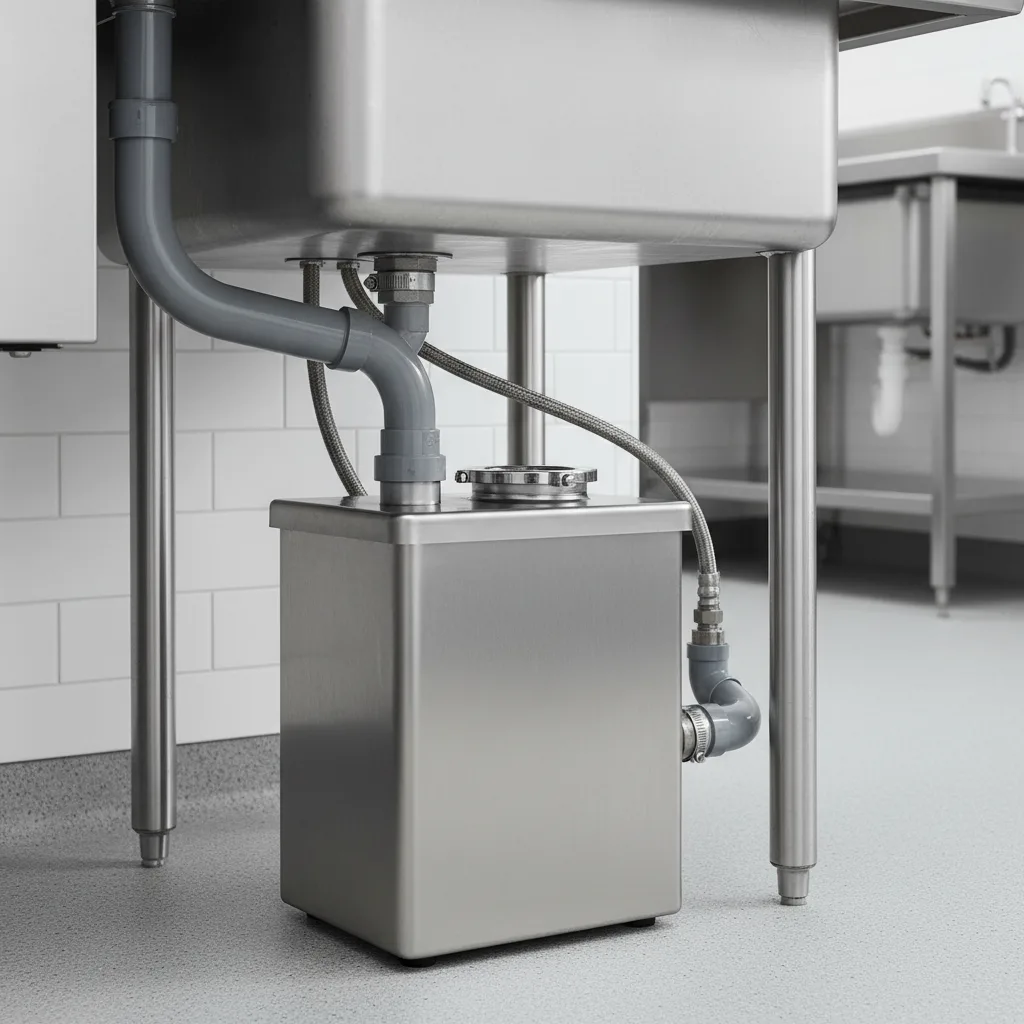
- Hydromechanical vs Gravity Interceptors: Small commercial kitchens typically utilize indoor Hydromechanical Grease Interceptors (HGI) installed on the floor or recessed under sinks (rated by flow rate, typically 20 to 100 GPM), whereas high-volume kitchens or whole-facility drainage require exterior Gravity Grease Interceptors (GGI) with liquid capacities from 750 to 2,000+ gallons.
- Physical Space, Venting & Clearances: Verify clearances above unit covers for baffle removal and pump-out wand access. Confirm proper plumbing venting and flow control valve placement in accordance with manufacturer specifications.
- Local Authority Plan Review & Permits: Submit plumbing schematics and fixture calculations to the local building, health, or sewer utility for review before purchasing equipment. Installing an unapproved model or incorrect capacity can result in failed plumbing inspections and costly retrofits.
Separate Equipment, Rough-In, and Maintenance Costs
When soliciting contractor bids, require proposals to distinctly itemize: (1) equipment purchase and freight, (2) rough-in plumbing and drainage connections, (3) concrete cutting, excavation, or structural restoration, (4) permit and municipal inspection fees, and (5) ongoing service access requirements.
| Planning Factor | 1. Compact Point-of-Use Hydromechanical (HGI) | 2. High-Capacity Hydromechanical (HGI) | 3. Conventional Gravity Grease Interceptor (GGI) | Primary Source Citation & Verifiable Claim Basis |
|---|---|---|---|---|
| Published Placement & Access Examples | Savannah Standard: describes hydro-mechanical interceptors as smaller units installed inside the building near the sink. Schier GB2-C product record: states indoor, above-grade or buried installation (with model-specific requirements and accessories). |
Schier GB-75-B & GB-250-B product records: state indoor or outdoor, above-grade or buried installation configurations. | Savannah Standard: describes gravity grease interceptors as large tanks or vaults, often outside, and requires interceptors to be directly accessible from the surface with an access opening of at least 18 x 18 inches. | City of Savannah Standard; Schier GB2-C, GB-75-B, and GB-250-B product records (see our Schier Great Basin review). |
| Published Sizing & Listing Basis | Savannah Standard (PDI-G101): sizes indoor hydro-mechanical units by flow rate (sink volume in cu in ÷ 231 × 0.75 load factor ÷ 1-minute drain time = GPM, selecting the next PDI size up; PDI sizes 4, 7, 10, 15, 20, 25, 35, 50, 75, 100 where grease capacity in lb is twice the GPM rating). City of Phoenix (1994 UPC table): 1 fixture = 20 GPM and 40 lb; 2 fixtures = 25 GPM and 50 lb; 3 fixtures = 35 GPM and 70 lb; 4 fixtures = 50 GPM and 100 lb. |
Schier Great Basin records: GB2-C (35 GPM; 130 lb grease capacity; 20 gal liquid capacity), GB-75-B (50 GPM; 730 lb grease capacity at 99%; 125 gal liquid capacity), and GB-250-B (75 GPM; 1,560 lb grease capacity at 99%; 277 gal liquid capacity) are listed by IAPMO to ASME A112.14.3 and CSA B481.1. A product listing does not by itself settle the local permit, sizing, or approval decision. | Austin Water: Flow rating = total fixture units × 3 gallons per minute. Minimum liquid holding capacity = flow rating × 12 minutes. City of Phoenix: 3 gallons per minute per connected fixture unit × required retention time (17 minutes in Phoenix’s published example without a solids interceptor). Savannah Standard: total fixture flow × 30-minute detention time, plus one-third of that detention volume for grease and solids storage (so storage equals 25% of total tank capacity). |
Savannah Standard; Austin Water Sizing Criteria; City of Phoenix Sizing Calculations; Schier Great Basin records. |
| Published Local Authority Minimums & Rules | Austin Water: describes smaller hydro-mechanical units as suited to low-grease businesses such as small sandwich shops, coffee shops, and bakeries that use disposable flatware and no automatic dishwasher; requires hydro-mechanical units to be flow-rated at 75 GPM or higher; and does not approve traps or interceptors below 100 gallons of liquid capacity. | Austin Water: requires hydro-mechanical units to be flow-rated at 75 GPM or higher, does not approve units below 100 gallons of liquid capacity, requires at least a 500-gallon interceptor for kitchens with a dishwasher, and advises not purchasing equipment before obtaining building plan approval and an Industrial Waste approval letter. | City of Phoenix: lists a 500-gallon (2 compartments) minimum grease interceptor size. Austin Water: requires a two-compartment trap or interceptor with a 12-minute total retention time for kitchens with dishwashers or wok stoves, and at least a 500-gallon interceptor with a dishwasher. Savannah Standard: requires hydraulic calculations signed by a registered civil engineer for new facilities. |
Austin Water Sizing Criteria; City of Phoenix Sizing Calculations; Savannah Standard. |
| Published Cost Examples (Named Sources Only) | City of Tampa utility FAQ: states the average install is $250–$1,500 for a small (0–100 gallon) grease trap (local utility example, not a national quote or guarantee). Schier 2026 wholesale list prices (equipment only, before freight, tax & installation): GB1 $984; GB2 $1,548; GB3 $2,523. |
Schier 2026 wholesale list prices (equipment only, before freight, tax & installation): GB-250 $6,931; GB-500 $15,300; GB-1000 $26,359; GB-1500 $33,606 (not a buyer-specific quote, and other product classes differ). | City of Tampa utility FAQ: states the average installation of a new 750–1,500-gallon grease trap is $4,000–$8,500 (Tampa local utility example, not a national quote or guarantee; gravity tank equipment and site work are quoted per project). | City of Tampa utility FAQ; Schier 2026 wholesale list prices. |
| Suggested Quote Questions for Bidders (Buyer Checklist — Not Universal Code Rules) | Suggested quote questions: Ask bidders to itemize in writing the exact model and suffix, freight, warranty, indoor plumbing and venting connections, flow-control valve placement per manufacturer instructions, permits, and clearance above covers for baffle removal and pump-out wand access. | Suggested quote questions: Ask bidders to itemize in writing the exact listed model and suffix, whether above-grade or buried installation applies, required finish covers, risers, supports or anchors, plumbing and venting connections, excavation/slab work (if buried), permits, and inspection access. | Suggested quote questions: Ask bidders to itemize in writing the approved tank model and rating, excavation, utilities, shoring, base, backfill, risers, lids and traffic loading, plumbing and venting connections, design/plan review, permits, inspections, and surface restoration. | Buyer bid-comparison checklist aligned with the itemized bid sections on this page and our Schier Great Basin review; binding rules are set by the local authority serving the property. |
Ongoing Ownership Costs
After installation, request separate local prices for pumping and disposal, inspection, repairs, replacement parts, and any required monitoring. Cleaning frequency depends on the local FOG program and measured accumulation. A fixed national annual-cost estimate would be unreliable.
Remote monitoring can help schedule service or keep compliance records, and prices depend on the product. Drain-Net lists a $1,200 portable probe and connected systems from $4,950 to $5,850.
Grease-discharge rules are mostly local: the sewer authority serving the property enforces its own rules and penalty schedule. For violations actually governed by 33 U.S.C. §1319(d), the current 40 CFR §19.4 table lists a federal statutory maximum of $68,445 per day per violation. That is a legal ceiling for covered federal enforcement, not the routine or automatic fine for a restaurant incident.
Frequently asked questions
Is there a dependable national installed price?
No single total covers equipment, plumbing, permits, excavation, utilities, access, restoration, and local requirements for every property.
What do manufacturer list prices prove?
They document named products and a date, not the final transaction or installed project.
Who approves the equipment and design?
The local plumbing, sewer, wastewater, or other authority serving the property controls the applicable approval.
Who sets the grease-trap rules for my property?
The authority serving the property sets the binding equipment, service, record, and enforcement requirements. Ask that authority for the current rule and keep the response with your service records.

Author: Grease Trap Locator Editorial Team
The Grease Trap Locator editorial team covers FOG compliance, grease trap maintenance, and commercial kitchen regulations across the US and Canada. Our guides are written for restaurant owners, facility managers, and food service operators who need practical, accurate information without the fluff.
Find local contractors who handle cleaning, pumping, and FOG compliance — in your area.